Performance Differences Between Synthetic Grease and Mineral Grease
Performance Differences Between Synthetic Grease and Mineral Grease
Synthetic and mineral greases are widely used across industrial equipment such as bearings, linear guides, motors, conveyor rollers, SMT machinery, and injection molding machines. While both types serve the same purpose—providing lubrication and reducing wear—their performance characteristics differ significantly due to variations in base oil chemistry and additive formulation. Understanding these differences is essential for selecting the appropriate grease for specific operating environments.
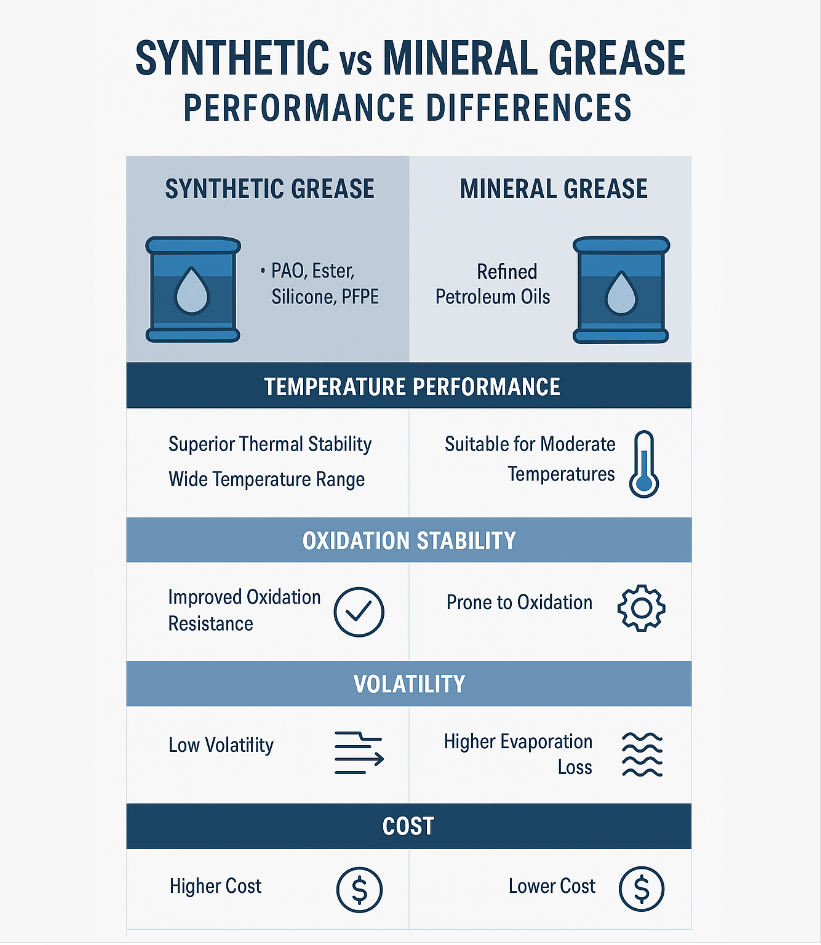
1. Base Oil Composition: The Core Difference
Mineral Grease
Derived from refined petroleum oils.
Features:
-
Economical
-
Suitable for general industrial conditions
-
Moderate thermal and oxidation stability
Synthetic Grease
Uses engineered base oils such as PAO, ester, silicone, or PFPE.
Advantages:
-
Superior chemical stability
-
Wider temperature range
-
Improved oxidation resistance
-
Lower volatility
Synthetic greases are ideal for demanding applications where mineral oils reach their limits.
2. Temperature Performance
Mineral Grease
Typically suitable for –20°C to 120°C, depending on the formulation.
Performance declines rapidly at elevated temperatures due to oxidation and evaporation.
Synthetic Grease
Provides a far broader temperature capability:
-
PAO grease: –50°C to 150°C
-
Ester grease: up to 180°C
-
Silicone grease: –60°C to 200°C
-
PFPE grease: –70°C to 250°C+
This makes synthetic grease preferred for high-temperature bearings, robotics, reflow oven conveyors, and electronics manufacturing.
3. Oxidation Stability and Service Life
Synthetic greases have inherently higher oxidation resistance due to stable molecular structures.
Benefits:
-
Longer lubrication intervals
-
Lower formation of sludge
-
Reduced bearing noise and wear
-
Lower risk of carbonization at high temperatures
Mineral greases oxidize faster and require more frequent replenishment.
4. Volatility and Evaporation Loss
Mineral Grease
Higher evaporation at elevated temperatures.
This leads to hardening, residue formation, and reduced lubrication effectiveness.
Synthetic Grease
Engineered for low volatility.
-
PFPE and silicone grease have extremely low evaporation loss.
-
Suitable for vacuum, cleanroom, semiconductor and high-heat applications.
5. Load-Carrying and Anti-Wear Performance
Synthetic greases can be formulated with advanced EP (Extreme Pressure) and AW (Anti-Wear) additives to improve load-carrying capacity.
Areas that benefit:
-
Heavy bearings
-
Gear couplings
-
Conveyors under shock load
-
Robotics joints & reducers
Mineral greases can provide adequate EP/AW performance but lose stability under extreme thermal or mechanical stress.
6. Compatibility Considerations
Mineral greases mix more easily with other petroleum-based greases.
Synthetic greases, especially:
-
Ester
-
Silicone
-
PFPE
are often not compatible with mineral oils.
Mixing incompatible greases can cause:
-
Thickener collapse
-
Separation
-
Loss of lubrication film
-
Premature bearing failure
Proper flushing or full grease replacement is required when switching to synthetic.
7. Cost vs. Value
Although synthetic grease is more expensive upfront, it delivers:
-
Longer re-lubrication intervals
-
Lower maintenance cost
-
Extended bearing service life
-
Reduced downtime
This results in lower total cost of ownership, especially for automated or high-duty systems.
Conclusion
The choice between mineral and synthetic grease should be based on application demands, operating temperature, environmental exposure, expected service life, and lubrication intervals. While mineral greases remain suitable for general-purpose industrial use, synthetic greases offer superior performance in high-temperature, long-life, high-speed, or chemically demanding environments.
Selecting the right grease ensures better equipment protection, reduced failures, and improved overall reliability.
Understanding Grease Consistency, Base Oil Viscosity, and Operating Temperature Range
Optimization of Lubrication Solutions for Conveyor Rollers and Bearings
Related Article