PFPE Grease Applications in Vacuum Environments
Introduction
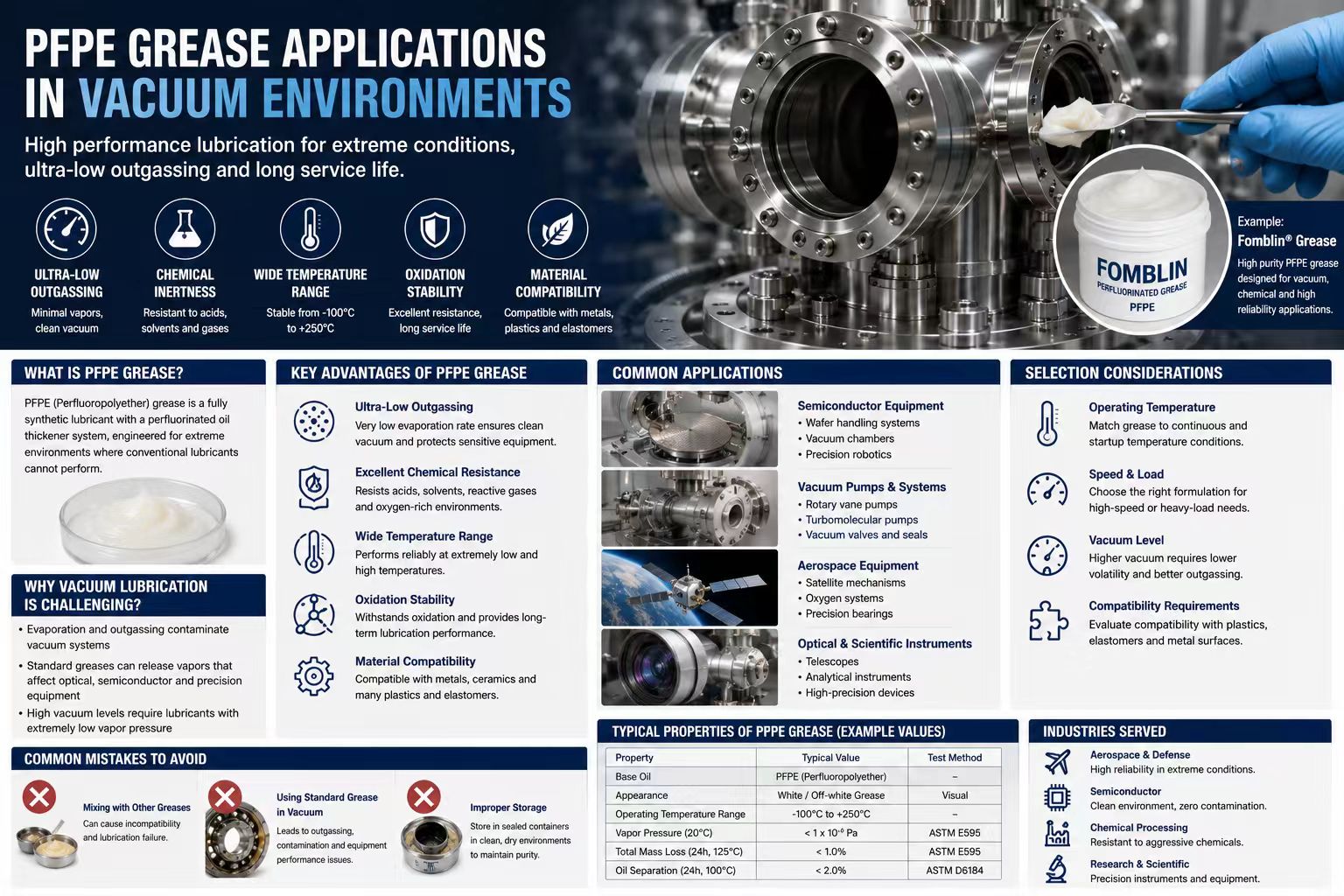
In high-vacuum and clean industrial environments, selecting the right lubricant is critical for ensuring equipment reliability and contamination control. PFPE grease is widely used in demanding applications due to its exceptional chemical stability, low volatility, and resistance to extreme temperatures.
This article explains the advantages of vacuum lubricant grease, common applications, and the key factors involved in vacuum environment lubrication systems.
What Is PFPE Grease?
PFPE (Perfluoropolyether) grease is a fully synthetic lubricant designed for extreme operating environments.
Key characteristics include:
- Excellent thermal stability
- Ultra-low vapor pressure
- Strong chemical inertness
- Non-flammability
- Long service life
Because of these properties, PFPE grease is commonly used in aerospace, semiconductor, vacuum, and precision manufacturing applications.
Typical example: Fomblin
Why Vacuum Environments Require Specialized Lubrication
Vacuum systems operate under conditions where conventional lubricants may fail due to:
- Evaporation
- Oxidation
- Outgassing
- Chemical decomposition
Standard mineral oil greases can release vapors that contaminate:
- Optical systems
- Semiconductor wafers
- Sensitive instruments
Therefore, specialized vacuum lubricant grease is essential.
Main Advantages of PFPE Grease
1. Ultra-Low Outgassing
One of the most important features of vacuum environment lubrication is minimizing vapor release.
PFPE lubricants provide:
- Very low evaporation rates
- Reduced contamination risk
- Stable vacuum performance
2. Excellent Chemical Resistance
PFPE grease resists:
- Acids
- Solvents
- Reactive gases
- Oxygen-rich environments
This makes it suitable for harsh chemical processes.
3. Wide Temperature Range
PFPE lubricants can operate under:
- Extremely low temperatures
- High continuous temperatures
without rapid degradation.
4. Oxidation Stability
Unlike many hydrocarbon lubricants, PFPE grease provides:
- Excellent oxidation resistance
- Long service life
- Reduced maintenance frequency
5. Material Compatibility
PFPE lubricants are generally compatible with:
- Metals
- Ceramics
- Many plastics and elastomers
However, compatibility testing is still recommended for critical applications.
Common PFPE Grease Applications
Semiconductor Equipment
Used in:
- Wafer handling systems
- Vacuum chambers
- Precision robotics
Vacuum Pumps and Systems
Require:
- Low vapor pressure
- Stable lubrication under vacuum
Aerospace Equipment
Used in:
- Satellite mechanisms
- Oxygen systems
- Precision bearings
Optical and Scientific Instruments
Need:
- Low contamination risk
- Long-term stability
Key Considerations When Selecting PFPE Grease
Operating Temperature
Choose grease suitable for:
- Continuous operating temperature
- Startup conditions
Speed and Load
Different formulations are optimized for:
- High-speed bearings
- Heavy-load applications
Vacuum Level
Higher vacuum levels require:
- Lower volatility lubricants
- Improved outgassing performance
Compatibility Requirements
Always evaluate:
- Elastomer compatibility
- Plastic compatibility
- Metal surface requirements
Common Mistakes to Avoid
Mixing PFPE with Other Greases
Can cause:
- Lubrication failure
- Chemical incompatibility
- Performance degradation
Using Standard Grease in Vacuum Systems
May result in:
- Outgassing contamination
- Reduced vacuum efficiency
- Equipment damage
Improper Storage
PFPE grease should be stored:
- In sealed containers
- Away from contaminants
- Under clean conditions
Conclusion
Reliable vacuum environment lubrication requires specialized lubricants capable of operating under extreme conditions. With excellent chemical stability, low outgassing, and long service life, PFPE grease remains one of the most effective solutions for critical vacuum applications.
Industrial Robot Grease Lubrication Solutions
Textile Machinery Grease Selection and Applications
Related Article