Mineral Oil vs Synthetic Grease: Performance Differences and Application Guide
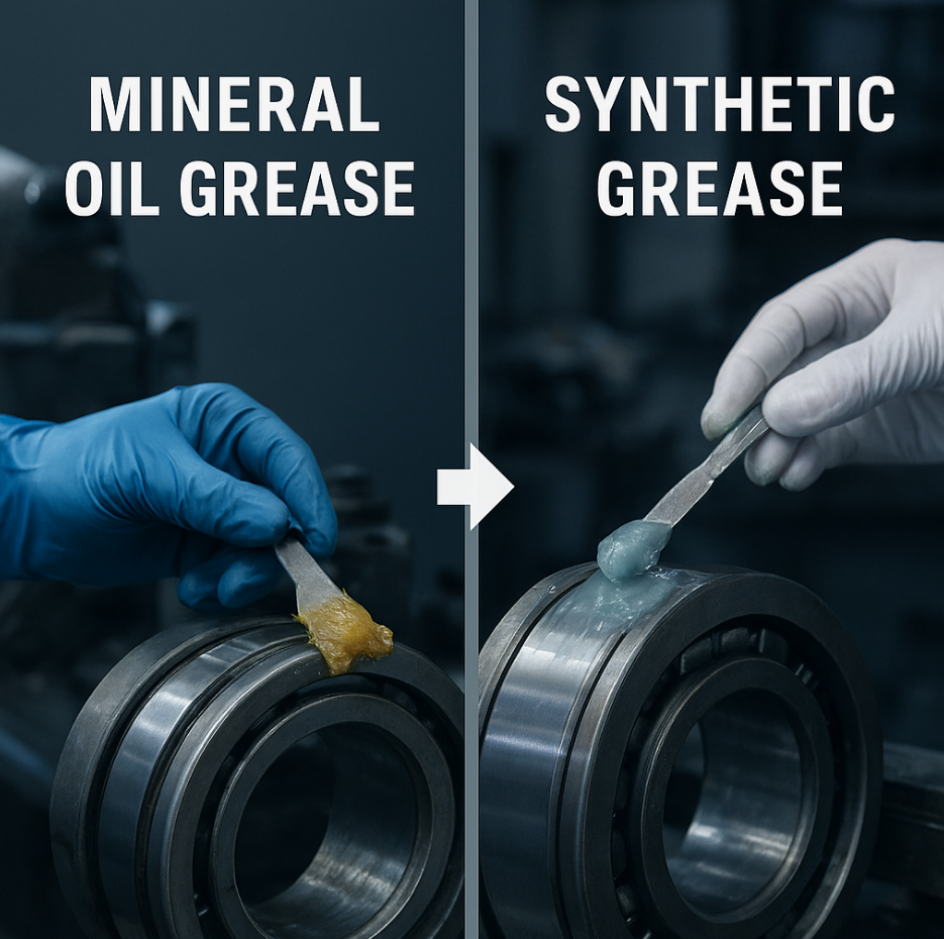
In grease formulation, the type of base oil is one of the most critical performance factors. The two main types are mineral oil and synthetic oil, each with distinct chemical structures, stability, and applications.
1. Mineral Oil Grease
Derived from refined petroleum, mineral oil grease offers low cost, good lubricity, and wide compatibility. It is suitable for moderate-speed, normal-temperature, and light-load machinery such as bearings, fans, and gearboxes.
Advantages: Affordable, widely available, compatible with many thickeners.
Disadvantages: Limited oxidation stability, poor high/low-temperature performance, and prone to evaporation.
2. Synthetic Grease
Made with chemically synthesized base oils (PAO, esters, PFPE, etc.), synthetic greases provide superior thermal stability and extended service life. They are ideal for high-temperature, high-speed, heavy-load, vacuum, or clean applications.
Advantages: Excellent thermal stability, oxidation resistance, low volatility, long life.
Disadvantages: Higher cost and possible compatibility concerns with seals.
3. Selection Tips
-
For general-purpose, cost-sensitive applications → Mineral oil grease.
-
For extreme or long-life requirements → Synthetic grease.
-
For semiconductor, food, or vacuum applications → PFPE-based grease is recommended.
✅ Conclusion:
Although synthetic greases are more expensive, their long-term reliability and extended re-lubrication intervals often make them the more economical choice for demanding operations.
How Klüber Lubrication Enhances Performance in Precision Machine Tools
How to Select the Right Grease for High Temperature, High Speed, and Heavy Load Applications?
Related Article