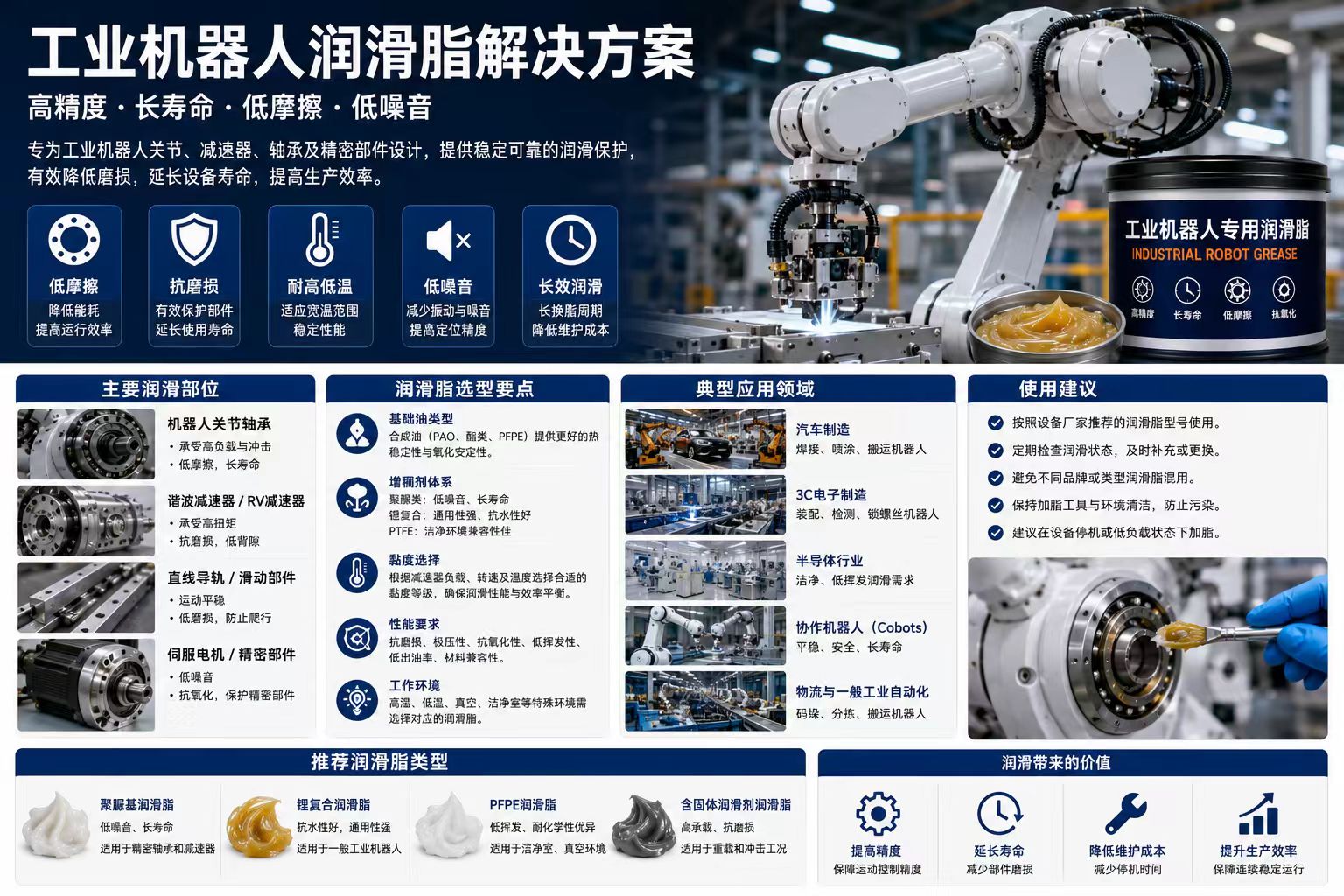
Industrial Robot Grease Lubrication Solutions
Introduction
Modern automation systems rely heavily on precise and reliable motion control, making proper industrial robot grease selection essential for stable performance and long equipment life.
Industrial robots operate continuously under complex movement patterns, high loads, and demanding environmental conditions. Effective robot lubrication solutions help reduce wear, minimize downtime, and improve positioning accuracy.
This article explains the key lubrication requirements and application methods for robotic arm grease and precision automation systems.
Why Industrial Robots Require Specialized Lubrication
Industrial robots contain multiple precision components operating under:
- Continuous movement
- Repetitive motion cycles
- High-speed acceleration and deceleration
- Heavy loads on joints and gears
- Precision positioning requirements
Improper lubrication may result in:
- Increased vibration
- Servo instability
- Gear wear
- Positioning errors
- Reduced equipment lifespan
Therefore, specialized precision equipment lubrication is critical in robotic systems.
Main Lubrication Points in Industrial Robots
Robot Joint Bearings
Require:
- Low friction
- Long service life
- Wear resistance
Harmonic Drives and Gear Systems
Need:
- Extreme pressure protection
- Stable lubrication film
- Low backlash performance
Linear Guides and Sliding Components
Require:
- Smooth movement
- Reduced vibration
- Corrosion resistance
Servo and Precision Components
Need:
- Low-noise grease
- Oxidation stability
- Consistent torque performance
Key Challenges in Robot Lubrication
1. High Precision Requirements
Robotic systems demand:
- Accurate motion control
- Stable repeatability
- Minimal vibration
Lubricants must maintain consistent performance over long operating cycles.
2. Continuous Operation
Many industrial robots operate:
- 24/7 production cycles
- High-duty automation lines
This requires long-life lubricants with strong oxidation resistance.
3. Wide Temperature Variations
Robots may operate in:
- High-temperature factories
- Cold storage environments
- Cleanrooms
Grease must remain stable across different temperatures.
4. Noise and Vibration Control
Low-noise lubrication is essential for:
- Precision assembly robots
- Semiconductor automation
- Electronic manufacturing systems
Selecting the Right Industrial Robot Grease
Base Oil Type
Common choices include:
- Synthetic PAO grease
- Ester-based lubricants
- PFPE grease for cleanroom environments
Synthetic lubricants provide:
- Better thermal stability
- Longer service life
- Lower friction
Thickener System
Typical thickener systems:
- Polyurea → low noise and long life
- Lithium complex → versatile industrial use
- PTFE thickener → cleanroom compatibility
Viscosity Selection
Proper viscosity depends on:
- Gear load
- Joint speed
- Operating temperature
Incorrect viscosity may increase servo resistance or reduce protection.
Oxidation and Wear Resistance
Robot grease should provide:
- Long relubrication intervals
- Anti-wear protection
- Minimal oil separation
Common Applications of Robot Lubrication
Automotive Production Robots
Require:
- Heavy-load protection
- Long service life
Semiconductor Robots
Need:
- Low outgassing
- Cleanroom-compatible grease
Electronics Assembly Robots
Require:
- Low-noise lubrication
- Precision movement stability
Collaborative Robots (Cobots)
Need:
- Smooth motion
- Consistent torque control
- Reduced maintenance
Best Practices for Robot Lubrication
Follow OEM Recommendations
Always use lubricants compatible with:
- Gear systems
- Seal materials
- Precision components
Avoid Grease Contamination
Use:
- Clean tools
- Sealed containers
- Controlled application methods
Monitor Lubrication Condition
Regular inspection helps identify:
- Noise changes
- Increased vibration
- Grease leakage
- Temperature rise
Avoid Mixing Different Greases
Incompatible lubricants may cause:
- Grease separation
- Reduced lubrication performance
- Premature component wear
Conclusion
Effective industrial robot grease selection is essential for maintaining reliable automation performance and long equipment life. By implementing proper robot lubrication solutions, manufacturers can improve precision, reduce maintenance costs, and optimize industrial robot reliability.
Injection Molding Machine Lubrication Guide
PFPE Grease Applications in Vacuum Environments
Related Article