How Does Vacuum Grease Work? Principles and Applications
1. What Is Vacuum Grease?
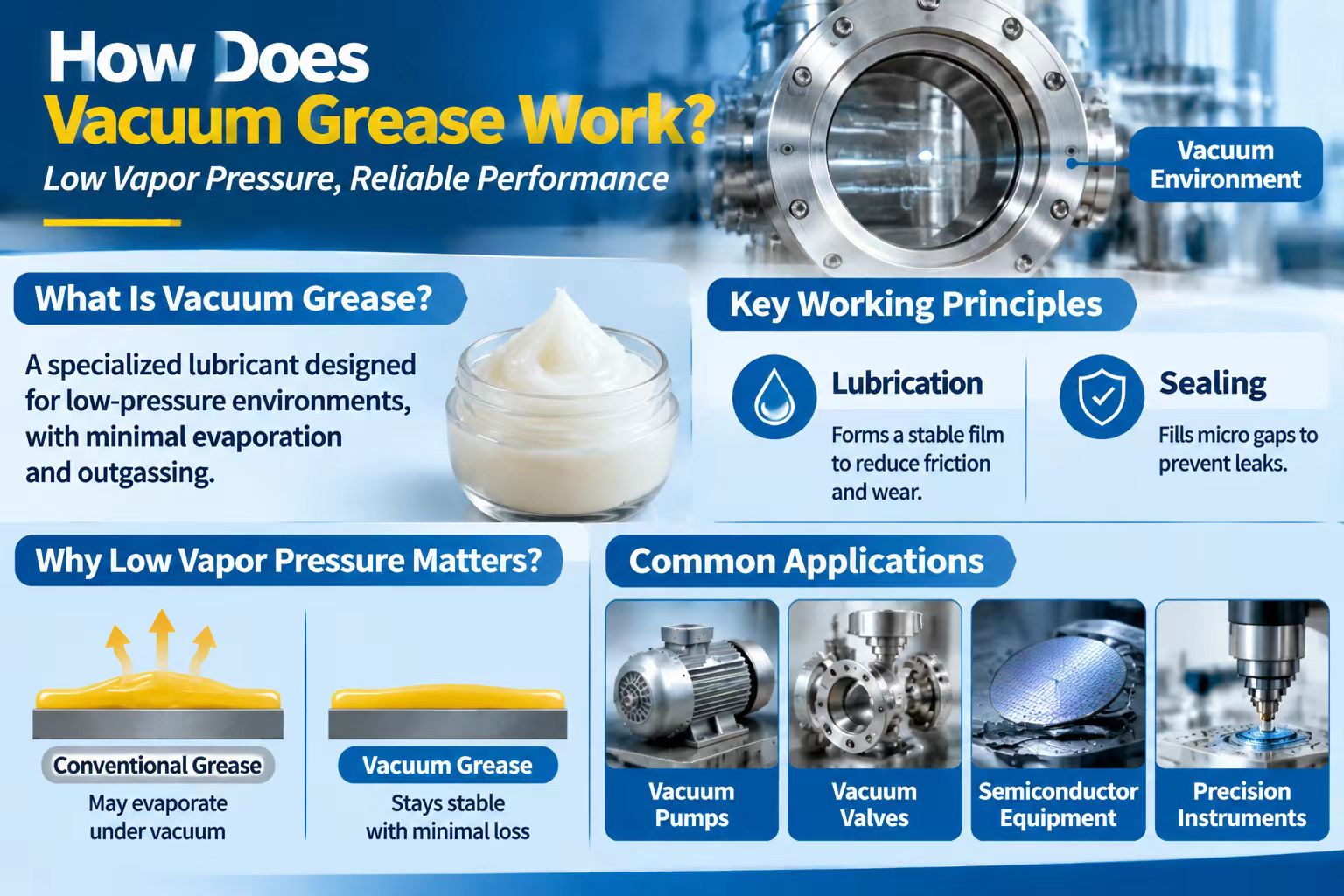
Vacuum grease is a specially formulated lubricant or sealing grease designed for use in low-pressure environments.
Unlike conventional grease, it must maintain its properties under vacuum while minimizing vaporization, outgassing, and contamination.
Depending on its formulation and application, vacuum grease may be used for:
-
Lubricating bearings and moving components.
-
Sealing glass joints, valves, and O-rings.
-
Reducing friction between contacting surfaces.
-
Protecting components from moisture and certain chemicals.
2. How Does Vacuum Grease Work?
Vacuum grease works through two main mechanisms: lubrication and sealing.
Lubrication: The grease forms a protective film between contacting surfaces, helping reduce direct metal-to-metal contact, friction, and wear.
Sealing: When applied as a thin film to suitable joints or O-rings, it helps fill microscopic surface irregularities and improve sealing performance.
Its thickener structure also helps retain the base oil at the application point, supporting consistent lubrication or sealing.
3. Why Is Low Vapor Pressure Important?
Under vacuum, volatile components can evaporate more readily. This may cause lubricant loss and allow vapor or condensable substances to contaminate nearby surfaces.
A suitable vacuum grease should therefore offer:
-
Low Vapor Pressure: Reduces the tendency of lubricant components to evaporate.
-
Low Outgassing: Helps minimize gas release from the lubricant.
-
Thermal Stability: Maintains performance at the actual operating temperature.
-
Low Volatility: Helps reduce lubricant loss and potential contamination.
Vapor pressure and outgassing are related but different properties. Both should be considered when selecting grease for demanding vacuum systems.
4. Common Types of Vacuum Grease
Different base oils and thickener systems are used depending on operating conditions.
| Grease Type | Typical Characteristics |
|---|---|
| Silicone-Based | Low volatility and good sealing properties in suitable applications |
| PFPE-Based | Excellent chemical inertness and low vapor pressure |
| Hydrocarbon-Based | Used in selected vacuum lubrication applications |
| Specialty Vacuum Grease | Formulated for specific vacuum levels, temperatures, and material requirements |
For example, Krytox LVP is a PFPE-based high-vacuum grease designed for demanding vacuum applications. Its manufacturer publishes extremely low vapor-pressure values, including data at elevated temperatures.
5. Typical Applications
Vacuum greases are used in various industrial and scientific systems, including:
-
Vacuum pumps and equipment
-
Vacuum valves and glass joints
-
O-rings and static sealing interfaces
-
Semiconductor manufacturing equipment
-
Laboratory instruments
-
Vacuum-compatible bearings and mechanical components
The correct product depends on whether the application requires sealing, bearing lubrication, or both.
6. How to Select the Right Vacuum Grease
Before choosing a vacuum grease, consider the following factors:
-
Vacuum Level: Confirm the required operating pressure and acceptable vapor pressure.
-
Operating Temperature: Evaluate vapor pressure and lubricant stability at actual service temperature.
-
Application Type: Distinguish between bearing lubrication and static sealing.
-
Material Compatibility: Check compatibility with metals, elastomers, plastics, and other contacting materials.
-
Contamination Requirements: Consider outgassing and the possibility of lubricant migration.
Always review the manufacturer's technical data and test compatibility under actual operating conditions.
Conclusion
Vacuum grease does more than provide conventional lubrication. It must maintain a stable lubricating or sealing film while minimizing evaporation, outgassing, and contamination under reduced pressure.
Selecting the right formulation requires evaluating vacuum level, temperature, material compatibility, and application requirements together.
Low Noise Grease: Technology and Industrial Applications
Related Article