Impact of Ball Screw and Guideway Lubrication on CNC Machining Accuracy
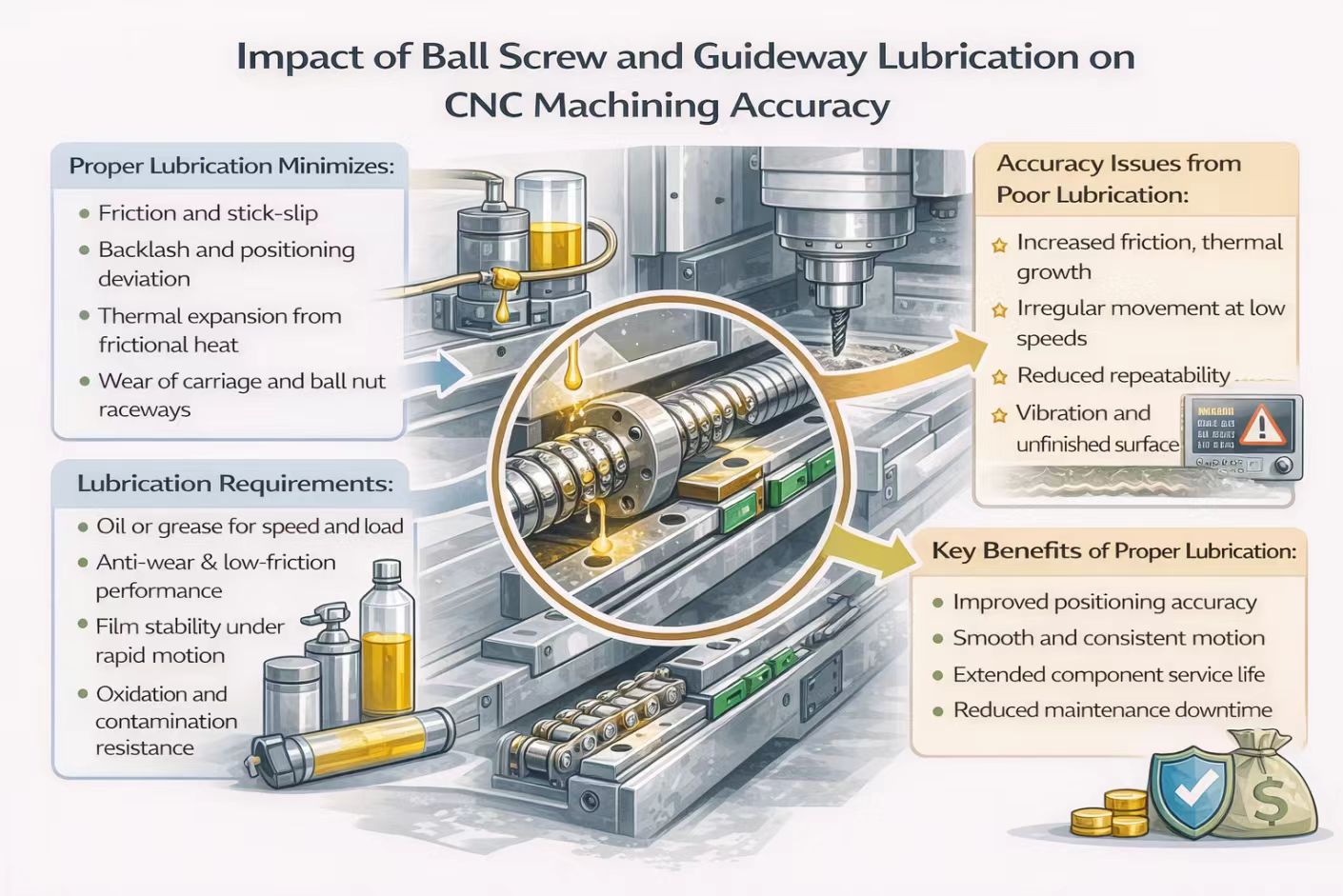
In CNC machine tools, ball screws and linear guideways are core motion components that directly affect positioning accuracy, repeatability, and surface finish. Proper lubrication of these precision elements plays a critical role in maintaining machining accuracy and long-term equipment stability.
As machining speeds increase and tolerance requirements become tighter, inadequate or improper lubrication can quickly lead to precision loss and premature component wear.
Role of Ball Screws and Guideways in CNC Accuracy
Ball screws convert rotary motion into precise linear movement, while guideways support and guide moving axes under load. Both components rely on a stable lubrication film to minimize friction, reduce wear, and ensure smooth motion.
Any increase in friction or variation in lubrication conditions can result in positioning deviation, backlash changes, and inconsistent feed motion.
Effects of Insufficient or Improper Lubrication
When lubrication is insufficient or unsuitable, several accuracy-related issues may occur:
-
Increased friction and stick-slip behavior
-
Thermal expansion due to frictional heat
-
Irregular motion at low feed rates
-
Accelerated wear of raceways and rolling elements
-
Reduced repeatability and dimensional accuracy
These effects are particularly noticeable in high-speed machining and precision finishing operations.
Lubrication Requirements for Precision Motion Components
Lubricants used for CNC ball screws and guideways should meet the following criteria:
-
Appropriate base oil viscosity for speed and load conditions
-
Excellent anti-wear performance to protect contact surfaces
-
Good oil film stability under continuous motion
-
Low friction characteristics to support smooth, precise movement
-
Resistance to oxidation and contamination
Specialized slideway oils or low-friction greases are commonly used, depending on the lubrication system design and operating environment.
Importance of Consistent Lubrication Supply
Automatic lubrication systems are widely applied in CNC machines to ensure consistent lubricant delivery. Proper adjustment of lubrication intervals and quantities is essential to avoid both starvation and over-lubrication, which can attract contaminants or interfere with motion accuracy.
Routine inspection of lubrication lines, distributors, and reservoirs helps maintain reliable lubrication performance.
Benefits of Optimized Lubrication Management
Effective lubrication management for ball screws and guideways delivers measurable benefits:
-
Improved positioning accuracy and repeatability
-
Reduced vibration and smoother axis motion
-
Extended service life of precision components
-
Lower maintenance costs and downtime
-
Stable machining performance over long production cycles
Selection of Anti-Stick and Anti-Wear Lubrication Materials in Electronic Component Assembly
Lubrication and Cleaning Maintenance of Transmission Chains in Automated Production Lines
Related Article