NLGI Grease Grades: How to Choose the Right Consistency
What Does NLGI Grade Mean?
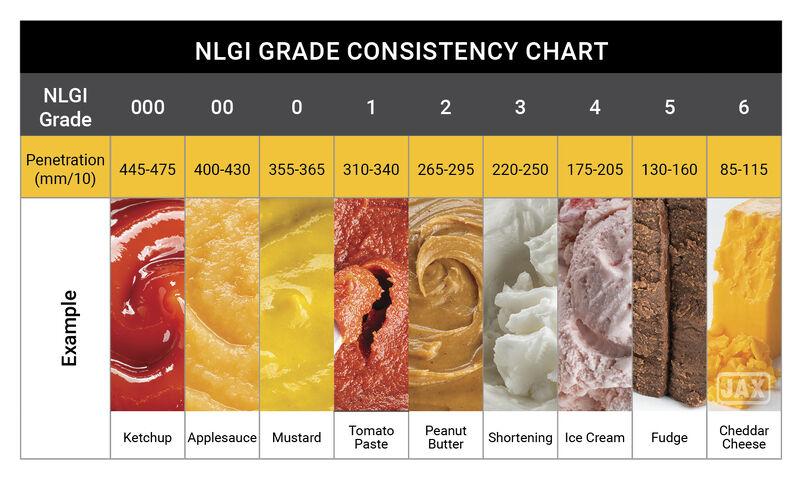
NLGI grade is a classification of grease consistency based on worked penetration at 25°C according to ASTM D217. A higher NLGI number means a harder and less easily flowing grease.
| NLGI Grade | Worked Penetration | General Consistency |
|---|---|---|
| 000 | 445–475 | Very fluid |
| 00 | 400–430 | Semi-fluid |
| 0 | 355–385 | Very soft |
| 1 | 310–340 | Soft |
| 2 | 265–295 | Normal |
| 3 | 220–250 | Firm |
| 4 | 175–205 | Very firm |
| 5 | 130–160 | Hard |
| 6 | 85–115 | Very hard |
NLGI 2 Is Not Always the Best Choice
NLGI 2 is one of the most commonly used grease consistencies, particularly for general bearing lubrication. However, the correct grade depends on the lubrication system, temperature, speed, load, sealing condition and grease delivery method.
For example:
- NLGI 000–0: useful for semi-fluid applications, enclosed systems and centralized lubrication.
- NLGI 1: softer grease with good pumpability, often considered where low-temperature or delivery requirements are important.
- NLGI 2: common general-purpose consistency for many bearings.
- NLGI 3: firmer grease that can be useful where better retention is required.
- NLGI 4–6: specialized, very firm greases used only in selected applications.
How to Choose the Right NLGI Grade?
1. Check the Lubrication System
For automatic or centralized lubrication, a softer grease may be required so that it can travel through pipes and dispensing equipment.
2. Consider Bearing Speed
High-speed bearings may require a grease with appropriate consistency, base-oil viscosity and formulation. NLGI grade alone cannot determine high-speed suitability.
3. Consider Temperature and Load
Temperature, load, vibration and operating conditions all affect grease selection. A higher NLGI number does not automatically mean better high-temperature or load performance.
4. Follow the Equipment Manufacturer's Specification
The manufacturer's recommended NLGI grade should be the starting point. When changing grease, also check base oil, thickener, additives and compatibility.
NLGI Grade vs. Grease Performance
NLGI grade describes consistency, not the overall performance level of a grease.
Two NLGI 2 greases can have completely different:
- Base oils
- Thickeners
- Temperature ranges
- Water resistance
- Load-carrying performance
- Oxidation stability
- Bearing speed capabilities
Therefore, grease selection should never be based on NLGI grade alone.
Conclusion
NLGI grade is a useful starting point for selecting grease consistency, but it is only one part of the specification. For reliable lubrication, match NLGI grade + base oil viscosity + thickener + operating temperature + speed + load + lubrication method to the actual equipment.
A properly selected NLGI grade helps ensure that grease can reach the lubrication point, remain in place and provide the required lubrication without unnecessary churning or leakage.
Why Is Silicone Grease Used in Electronics?
Related Article