Grease and Plastic Component Compatibility: Key Factors and Industry Insights
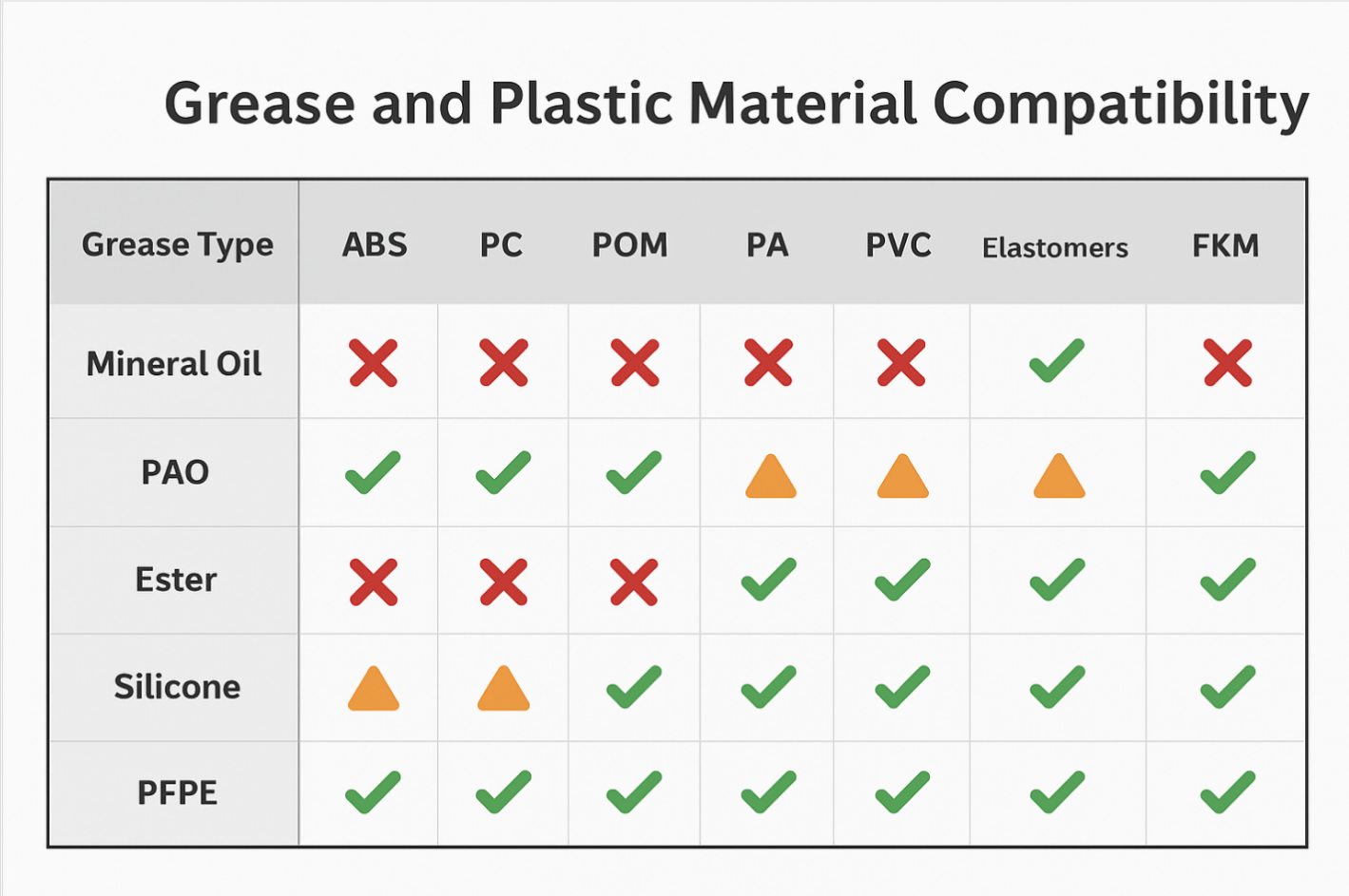
In modern electronics, automation, and precision machinery, lubricants frequently come into contact with plastic components such as gears, sliders, housings, seals, and connectors. Selecting a grease that is compatible with these materials is essential to prevent swelling, cracking, softening, or chemical degradation of plastic parts. This article explains the compatibility factors, common failure modes, and best-practice recommendations.
1. Why Grease–Plastic Compatibility Matters
Plastic materials are widely used in:
-
Electronic devices
-
Automotive actuators
-
Office equipment
-
Robotics and automation components
-
SMT machinery sliders and small transmission parts
However, certain lubricants—especially those containing aromatic oils, esters, additives, or solvents—may interact with plastics and cause deformation or loss of mechanical strength. Ensuring compatibility improves product lifetime, dimensional stability, and operational reliability.
2. Common Plastic Materials and Their Compatibility Characteristics
ABS (Acrylonitrile Butadiene Styrene)
-
Sensitive to mineral oils and ester oils
-
Risk of surface stress cracking
-
Best used with: PAO, silicone, PFPE greases
PC (Polycarbonate)
-
Very sensitive to oils and solvents
-
Mineral oils may cause stress cracking
-
Best used with: PFPE and silicone greases due to low reactivity
POM (Acetal / Delrin)
-
Good compatibility with most synthetic oils
-
Avoid grease with aggressive additives
-
Best used with: PAO, ester, and some lithium soap greases
PA (Nylon)
-
Can absorb oils, leading to swelling
-
Compatible with most PAO and ester oils
-
Best used with: light synthetic greases with stable thickener systems
PVC
-
Highly sensitive; can be softened by oils
-
Best used with: PFPE greases due to chemical inertness
Elastomers (Seals/O-Rings)
| Material | Compatibility Notes |
|---|---|
| NBR | Good with mineral & PAO, poor with ester oils |
| EPDM | Avoid mineral oils; prefer synthetic or silicone greases |
| FKM/Viton | Excellent chemical resistance; compatible with most oils |
| FFKM | Almost universal compatibility, including PFPE |
3. Base Oil Types and Their Compatibility Trends
1) Mineral Oil Grease
-
Economical
-
Can soften or crack sensitive plastics
-
Not recommended for PC, ABS, or PVC
2) PAO (Polyalphaolefin) Synthetic Grease
-
Good balance of compatibility
-
Safe for ABS, POM, Nylon
-
Preferred for small gears and actuators
3) Ester Oil Grease
-
Excellent lubrication, but may attack certain plastics
-
Avoid with PC, PVC, NBR
-
Suitable for POM and Nylon components
4) Silicone Grease
-
Very high plastic compatibility
-
Stable, non-reactive
-
Ideal for consumer electronics, valves, and O-rings
5) PFPE Grease
-
Chemically inert
-
Best universal compatibility
-
Suitable for high-value electronics, precision actuators, and cleanroom equipment
4. Common Failure Modes Caused by Incompatible Greases
-
Swelling or softening of plastic gears and sliders
-
Stress cracking, especially in PC housings
-
Dimensional changes leading to increased friction
-
Seal leakage caused by elastomer deterioration
-
Loss of mechanical strength in long-term operation
These failures often lead to noise, jamming, shortened service life, or complete component failure.
5. Best Practices for Selecting Compatible Grease
-
Verify material specifications (ABS, PC, POM, etc.)
-
Match base oil type to plastic sensitivity
-
Test compatibility in accelerated aging conditions (70–100°C)
-
Avoid additives with aggressive polarity
-
When unsure, choose PFPE or silicone grease, which have nearly universal compatibility
Conclusion
Grease–plastic compatibility is a critical factor in electronic devices, automation systems, and precision machinery. Understanding the behavior of different plastic materials and selecting a chemically compatible lubricant can significantly improve equipment reliability and lifespan.
Significance of ISO 21469 and NSF H1 Certifications for Industrial Lubricants
Food-Grade (H1) Grease Applications in Electronics and Industrial Machinery
Related Article