Food-Grade (H1) Grease Applications in Electronics and Industrial Machinery
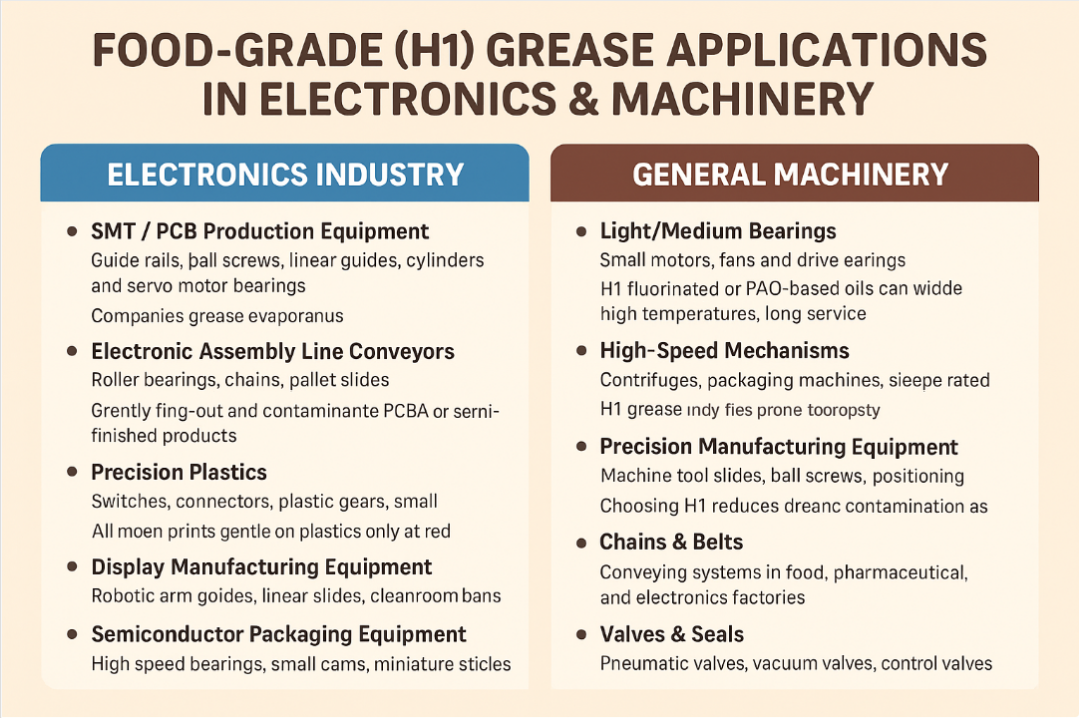
Food-grade (H1) grease is typically associated with food and beverage processing, but its use has expanded significantly into electronics manufacturing, precision machinery, and general industrial equipment. The key advantage of H1 lubricants is their ability to provide reliable lubrication while meeting strict safety requirements for environments where incidental contact with products must be avoided.
In modern electronics and industrial automation, H1 grease offers low volatility, material compatibility, clean performance, and excellent stability, making it suitable for sensitive equipment and cleanroom-grade applications.
1. Applications in the Electronics Industry
SMT / PCB Production Equipment
H1 grease is widely used in:
-
Linear guides
-
Ball screws
-
Stepper and servo motor bearings
-
Precision cylinders and actuators
Its low evaporation rate and clean formulation help minimize contamination risks on PCBs, optics, and precision components.
Electronic Assembly Conveyors
Roller bearings, chains, transport guides, and pallet slides benefit from H1 greases due to:
-
Reduced particle generation
-
Stable lubrication under continuous operation
-
Lower risk of residue or oil mist contamination
Precision Plastic Components
H1 greases often use synthetic PAO or PFPE base oils that:
-
Are compatible with sensitive plastics (ABS, PC, POM)
-
Avoid swelling, cracking, or discoloration
-
Ensure smooth motion in switches, connectors, and miniature gears
Cleanroom & Display Manufacturing Equipment
Robotic arms, optical assembly tools, and cleanroom conveyors require lubricants with:
-
Very low volatility
-
Minimal outgassing
-
Excellent chemical inertness
Some H1 greases meet both cleanroom and ISO Class 5–7 equipment requirements.
2. Applications in General Industrial Machinery
Light & Medium-Duty Bearings
H1 greases with PAO or fluorinated oils perform well in:
-
Small motors
-
Fans
-
Conveyor drives
They offer good oxidation stability and long re-lubrication intervals.
High-Speed Mechanisms
Packaging, cutting, and centrifuge mechanisms require lubricants with:
-
High shear stability
-
Low internal friction
-
Excellent temperature resistance
Certain H1 greases maintain performance at speeds where mineral greases would degrade.
Precision Manufacturing Equipment
Machine tools and positioning systems use H1 grease on:
-
Ball screws
-
Linear modules
-
High-precision guideways
The clean formulation reduces contamination risks to semi-finished parts.
Conveying Systems
Used in:
-
Pharmaceutical factories
-
Electronics environments
-
Light-industrial transport lines
H1 greases help minimize contamination while ensuring smooth transport.
Valves and Seals
H1 greases support pneumatic and vacuum control valves by:
-
Preventing seal wear
-
Reducing sticking
-
Maintaining stability across temperature fluctuations
3. Why H1 Grease Is Expanding Beyond Food Industry
Key advantages that drive adoption:
-
Low odor and low residue
-
Chemical and plastic compatibility
-
High-purity base oils
-
Low volatility and reduced outgassing
-
Compliance with NSF H1 and ISO 21469 standards
For electronics or precision machinery where contamination control is critical, H1 grease provides a high level of safety and cleanliness.
Conclusion
Food-grade (H1) lubricants are no longer limited to food plants—they are now essential in electronics manufacturing, automation systems, cleanroom production, and general industrial machinery. Their combination of safety, stability, and cleanliness makes them a reliable choice for sensitive and high-precision applications.
Grease and Plastic Component Compatibility: Key Factors and Industry Insights
Understanding Grease Consistency, Base Oil Viscosity, and Operating Temperature Range
Related Article