Lubrication Optimization Case Study for SMT Pick-and-Place Machine Drive Components
1. Background
SMT pick-and-place machines operate at extremely high speeds and positioning accuracy. Their drive components—such as ball screws, linear guides, belts, cams, and reduction mechanisms—are subject to continuous motion, rapid acceleration, and frequent start-stop cycles.
In one SMT production line, recurring issues such as abnormal noise, positioning deviation, and increased maintenance frequency were observed. A structured lubrication optimization project focusing on SMT machine lubrication was therefore implemented to improve reliability and equipment stability.
2. Operating Conditions of SMT Drive Components
The drive components of SMT pick-and-place machines typically face:
-
High-speed reciprocating motion
-
Light to medium loads with high frequency
-
Strict cleanliness requirements
-
Sensitivity to lubrication viscosity and resistance
Under such conditions, improper lubrication can easily cause friction instability, leading to vibration and accuracy loss. Effective drive component lubrication optimization is essential for maintaining consistent placement performance.
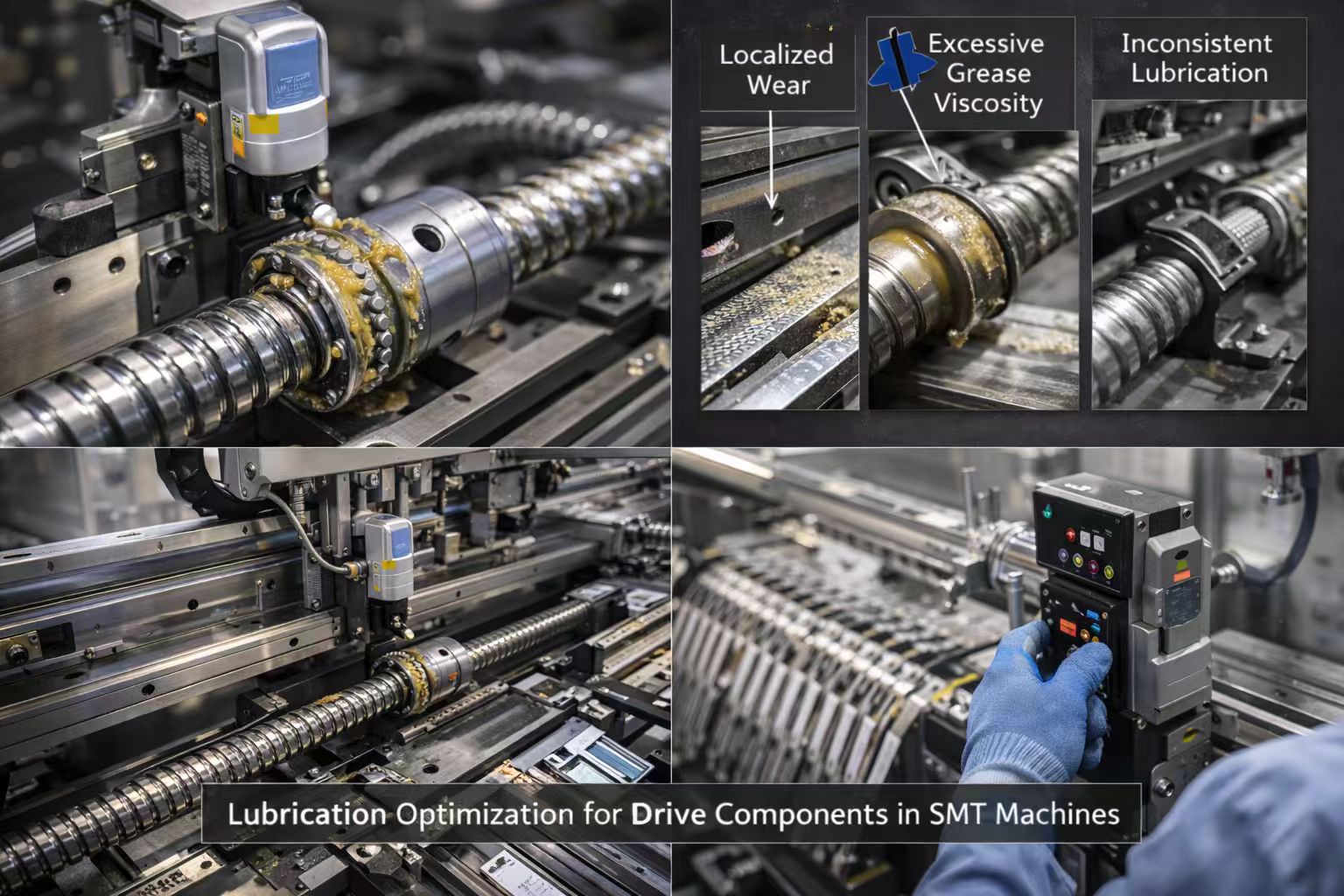
3. Identified Lubrication Issues
During inspection, the following lubrication-related problems were identified:
-
Grease aging caused increased friction in ball screws
-
Excessive grease viscosity affected high-speed response
-
Uneven lubrication led to localized wear on linear guides
-
Manual lubrication intervals were inconsistent
These issues directly impacted equipment precision and uptime, highlighting the need for improved SMT machine lubrication practices.
4. Lubrication Optimization Measures
4.1 Grease Selection Adjustment
The original grease was replaced with a low-viscosity synthetic grease designed for high-speed precision motion. This improved lubricating film stability and reduced drag, supporting smoother drive component lubrication optimization.
4.2 Lubrication Quantity Control
Lubrication quantities were standardized to avoid over-application. Excess grease was found to increase resistance and attract contaminants, which negatively affected precision movement.
4.3 Optimized Lubrication Intervals
Re-lubrication intervals were redefined based on operating hours rather than fixed calendar schedules. This ensured consistent SMT machine lubrication throughout continuous production cycles.
4.4 Introduction of Semi-Automatic Lubrication
For critical ball screws and linear guides, semi-automatic lubrication devices were introduced to ensure stable grease supply and reduce human error.
5. Performance Results After Optimization
After implementing the lubrication optimization measures, the following improvements were recorded:
-
Reduction in abnormal noise and vibration
-
Improved placement accuracy consistency
-
Extended maintenance intervals
-
Lower unplanned downtime
These results demonstrated the effectiveness of a structured precision equipment lubrication strategy tailored to SMT applications.
6. Lessons Learned and Best Practices
Key takeaways from this case include:
-
Lubricant selection must match speed and precision requirements
-
Over-lubrication can be as harmful as under-lubrication
-
Consistent lubrication control improves repeatability
-
Lubrication should be treated as a precision process, not a routine task
Applying these principles supports long-term reliability in precision equipment lubrication for SMT production lines.
7. Conclusion
This case study shows that targeted lubrication optimization can significantly enhance SMT pick-and-place machine performance. By refining grease selection, lubrication quantity, and maintenance methods, manufacturers can achieve stable, high-precision operation through effective drive component lubrication optimization and well-managed SMT machine lubrication.
Common Lubrication Problems and Solutions for Injection Mold Ejector Pins and Sliders
Long-Life Lubrication Strategies for Industrial Ball Screws
Related Article