Lubrication Improvement Strategies for Wear Issues in Injection Molding Machine Guide Pillars and Slides
Guide pillars and sliding components are critical precision parts in injection molding machines. They ensure mold alignment, smooth movement, and consistent product quality. However, due to high loads, repeated cycles, and harsh operating environments, wear on guide pillars and slides is a common maintenance challenge.
Optimizing lubrication is one of the most effective ways to reduce wear, extend component life, and stabilize machine performance.
1. Common Wear Problems in Guide Pillars and Slides
Typical wear-related issues include:
-
Surface scoring and abrasion
-
Increased friction and vibration
-
Uneven mold movement
-
Loss of positioning accuracy
-
Accelerated corrosion due to moisture or contaminants
These problems are often caused by insufficient lubrication, lubricant degradation, contamination, or improper grease selection.
2. Operating Conditions Affecting Lubrication Performance
Guide pillars and slides operate under:
-
High surface pressure
-
Low to medium sliding speed
-
Frequent start-stop motion
-
Elevated ambient temperatures
-
Exposure to dust, resin fumes, and moisture
These conditions demand lubricants with strong load-carrying capacity, good adhesion, and resistance to washout and oxidation.
3. Key Lubrication Improvement Approaches
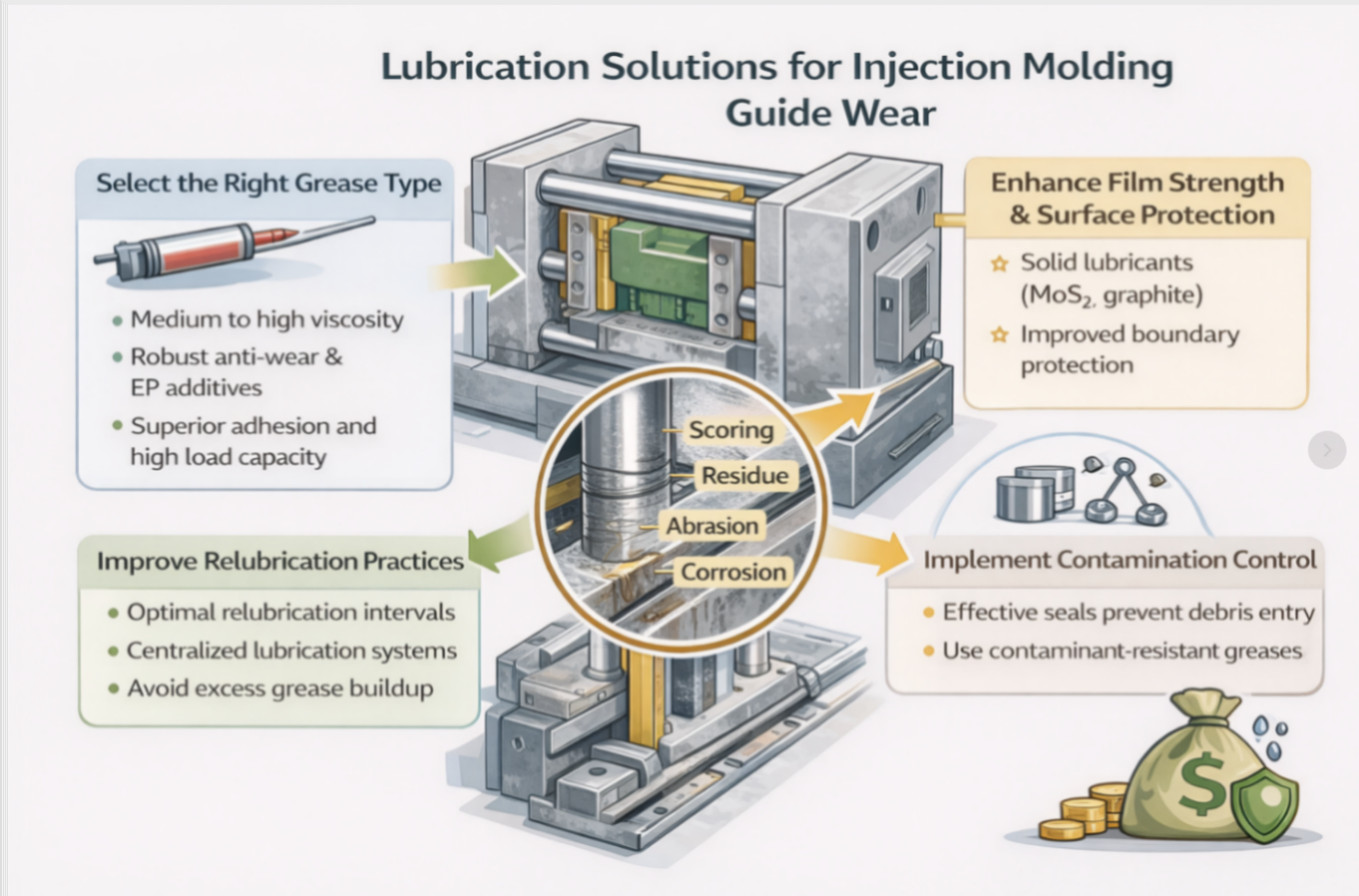
1) Selecting the Right Grease Type
For guide pillars and slides, suitable greases typically feature:
-
Medium to high base oil viscosity
-
Excellent anti-wear and EP performance
-
Strong mechanical stability
-
Good adhesion to vertical surfaces
Commonly used grease technologies include lithium complex, calcium sulfonate complex, and solid-lubricant-containing greases.
2) Enhancing Film Strength and Surface Protection
Greases with solid lubricants such as graphite, MoS₂, or PTFE can provide additional surface protection during boundary lubrication conditions, especially during startup or heavy load phases.
3) Improving Relubrication Practices
-
Avoid over-lubrication, which may attract contaminants
-
Establish proper relubrication intervals based on cycle count and temperature
-
Use centralized lubrication systems where possible for consistent supply
4) Contamination Control
Effective sealing and regular cleaning of guide surfaces help prevent abrasive particles from accelerating wear. Using greases with good contamination tolerance further enhances protection.
4. Benefits of Optimized Lubrication
Implementing proper lubrication improvements can deliver:
-
Reduced wear and surface damage
-
Improved mold alignment and repeatability
-
Lower maintenance frequency and downtime
-
Extended service life of guide pillars and slides
-
More stable injection molding process
Conclusion
Wear in injection molding machine guide pillars and slides is largely influenced by lubrication quality and management. By selecting greases designed for high-load sliding applications and optimizing lubrication practices, manufacturers can significantly improve equipment reliability and reduce long-term maintenance costs.
Lubrication and Cleaning Maintenance of Transmission Chains in Automated Production Lines
The Role of Lubricants in Energy Efficiency and Maintenance Cost Control
Related Article