Common Lubrication Problems and Solutions for Injection Mold Ejector Pins and Sliders
1. Background
Ejector pins and sliders are essential moving components in injection molds. They operate under repeated motion, high contact pressure, and elevated temperatures during molding cycles.
Improper lubrication of these components often leads to sticking, wear, or unstable movement, directly affecting mold reliability and product quality.
Addressing lubrication-related issues through effective injection mold lubrication practices is critical for maintaining consistent mold performance and reducing downtime.
2. Operating Characteristics of Ejector Pins and Sliders
Ejector pins and sliders typically experience:
-
High-frequency reciprocating motion
-
Localized high contact stress
-
Exposure to heat from molten plastic and mold temperature control
-
Limited lubrication access during production
These conditions make ejector pin lubrication and slider lubrication particularly challenging in injection molding environments.
3. Common Lubrication Problems
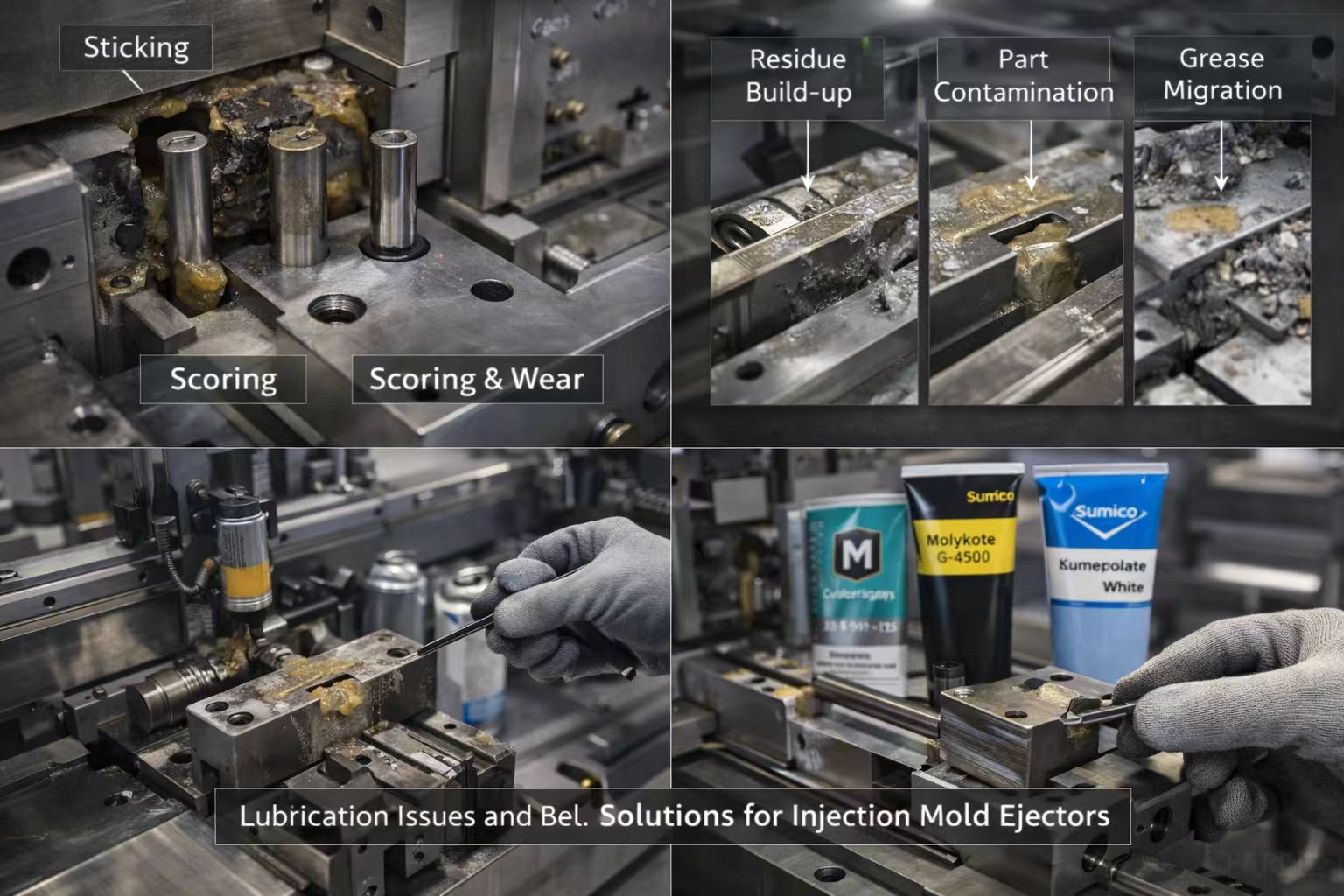
3.1 Sticking or Slow Return
One of the most common issues is ejector pins or sliders sticking during movement.
This is often caused by grease degradation, carbonization at high temperatures, or insufficient lubrication.
Inadequate ejector pin lubrication can result in delayed mold opening or incomplete ejection.
3.2 Accelerated Wear and Scoring
Without a stable lubricating film, metal-to-metal contact increases.
This leads to surface wear, scoring, and loss of dimensional accuracy, especially in sliding components requiring precise alignment.
Effective slider lubrication helps minimize friction and extend component service life.
3.3 Grease Hardening or Residue Formation
Grease exposed to prolonged high temperatures may harden or form residues.
These residues can restrict movement and increase friction rather than reduce it, negatively impacting injection mold lubrication performance.
3.4 Contamination of Molded Parts
Excessive or unsuitable grease may migrate to cavity areas, causing contamination of molded parts.
This is a common concern in precision or appearance-sensitive plastic products.
4. Root Causes of Lubrication Issues
Common underlying causes include:
-
Use of grease with insufficient thermal stability
-
Incorrect grease viscosity or consistency
-
Over-application or uneven application
-
Infrequent cleaning during maintenance
Understanding these causes is essential for improving ejector pin lubrication and slider lubrication reliability.
5. Lubrication Solutions and Best Practices
5.1 Selection of Thermally Stable Grease
Choose grease designed for high-temperature operation with good oxidation resistance.
Thermally stable lubricants reduce carbonization and residue formation, improving long-term injection mold lubrication.
5.2 Controlled Grease Application
Apply grease in thin, even layers.
Avoid over-lubrication, which can increase drag and contamination risk, particularly for slider lubrication areas.
5.3 Regular Cleaning and Re-Lubrication
Before applying fresh grease, remove degraded lubricant and debris.
This ensures new grease can form an effective lubricating film for reliable ejector pin lubrication.
5.4 Maintenance Interval Optimization
Lubrication intervals should be adjusted based on mold operating temperature, cycle time, and production volume rather than fixed schedules.
6. Common Problems and Solutions Overview
| Problem | Likely Cause | Recommended Solution |
|---|---|---|
| Ejector pin sticking | Grease degradation at high temperature | Use thermally stable grease and clean regularly |
| Slider wear | Insufficient lubrication film | Improve grease selection and application method |
| Residue buildup | Poor heat resistance or excess grease | Select low-residue grease and control quantity |
| Part contamination | Grease migration | Reduce application amount and optimize location |
7. Conclusion
Lubrication problems in ejector pins and sliders are common but manageable. By selecting appropriate lubricants, controlling application quantity, and implementing regular maintenance routines, manufacturers can significantly improve mold reliability through effective injection mold lubrication, stable ejector pin lubrication, and optimized slider lubrication practices.
The Impact of Grease Selection on Equipment Lifespan in Automated Production Lines
Lubrication Optimization Case Study for SMT Pick-and-Place Machine Drive Components
Related Article