How to Extend Grease Relubrication Intervals: Practical Guide
Regular relubrication is essential for maintaining bearing and machinery performance. However, excessively short grease relubrication intervals can increase maintenance costs, while intervals that are too long may result in lubricant degradation and bearing damage.
The goal is not simply to add grease less frequently. Instead, the relubrication interval should be optimized through proper grease selection, correct filling quantity, temperature control, contamination prevention, and equipment condition monitoring.
This article explains practical methods for extending grease relubrication intervals while maintaining reliable bearing lubrication.
What Determines Grease Relubrication Intervals?
The service life of grease depends on several operating factors:
- Bearing speed
- Operating temperature
- Load
- Bearing type
- Lubricant type
- Contamination
- Water exposure
- Sealing condition
- Operating hours
Therefore, there is no single relubrication interval suitable for every application.
1. Select the Right Grease
Choosing the correct grease is one of the most effective ways to extend lubrication intervals.
Different applications require different grease properties.
High-Speed Bearings
High-speed bearings require grease with:
- Low friction
- Low torque
- Good mechanical stability
- Suitable oil viscosity
- Good oxidation resistance
Recommended Grease
- Klüber ISOFLEX TOPAS NB 52
- NSK LR3
Typical applications:
- CNC spindle bearings
- Precision machinery
- Electric motors
- High-speed equipment
2. Choose Long-Life Grease for Continuous Operation
For equipment operating continuously or in difficult-to-access locations, a long-life grease can help reduce maintenance frequency.
Important properties include:
- Oxidation resistance
- Thermal stability
- Low evaporation
- Mechanical stability
- Long service life
Recommended Grease
- Kyodo Yushi Multemp SRL
- Klüber PETAMO GHY 133N
These types of products may be considered for applications where long relubrication intervals are required, subject to the equipment manufacturer's specifications.
3. Avoid Over-Greasing
Adding more grease does not necessarily extend the lubrication interval.
Excessive grease can cause:
- Churning
- Increased friction
- Higher bearing temperature
- Grease leakage
- Accelerated grease degradation
This is particularly important for:
- High-speed bearings
- Electric motors
- Precision equipment
Solution
Follow the recommended grease quantity for the specific bearing and application.
4. Avoid Under-Greasing
Insufficient grease can result in:
- Inadequate oil film
- Increased friction
- Bearing overheating
- Accelerated wear
Long relubrication intervals should therefore not be achieved by simply reducing the grease quantity.
The correct approach is to determine the appropriate grease quantity and interval according to actual operating conditions.
5. Control Operating Temperature
Temperature has a major effect on grease life.
Higher temperatures generally accelerate:
- Oxidation
- Base oil evaporation
- Additive depletion
- Thickener degradation
For high-temperature applications, use grease specifically designed for the operating temperature.
Recommended Grease
- Klüber PETAMO GHY 133N
- Kyodo Yushi Multemp PS No.2
Typical applications may include:
- High-temperature bearings
- Industrial motors
- Steel processing equipment
- Drying equipment
6. Prevent Water and Contamination
Contamination can significantly shorten grease service life.
Common contaminants include:
- Dust
- Water
- Metal particles
- Chemicals
- Process debris
These contaminants may accelerate grease degradation and bearing wear.
Prevention
- Maintain effective bearing seals.
- Clean grease fittings before relubrication.
- Keep grease containers closed.
- Use clean lubrication tools.
- Prevent direct water spray onto bearing housings.
For wet environments, select grease with appropriate water resistance.
Recommended Grease
- SKF LGWM 2
7. Maintain Good Sealing Performance
A good sealing system can help prevent both lubricant loss and contaminant entry.
Damaged seals may result in:
- Grease leakage
- Water contamination
- Dust contamination
- Shorter grease life
Therefore, seal inspection should be included in routine lubrication maintenance.
8. Avoid Mixing Incompatible Greases
Changing grease without checking compatibility may negatively affect lubrication performance.
Different greases may use different:
- Base oils
- Thickeners
- Additive systems
Potential problems include:
- Softening
- Hardening
- Oil separation
- Reduced mechanical stability
Solution
Before changing grease:
- Check grease compatibility.
- Consult the lubricant manufacturer.
- Remove old grease when necessary.
- Apply the new grease according to the recommended procedure.
9. Optimize Relubrication Intervals Through Condition Monitoring
Instead of relying only on fixed maintenance schedules, condition monitoring can help optimize lubrication intervals.
Monitor:
- Bearing temperature
- Vibration
- Noise
- Grease condition
- Lubricant leakage
If these parameters remain stable, maintenance teams can use operating data to evaluate whether the existing interval is appropriate.
This approach is commonly known as condition-based lubrication.
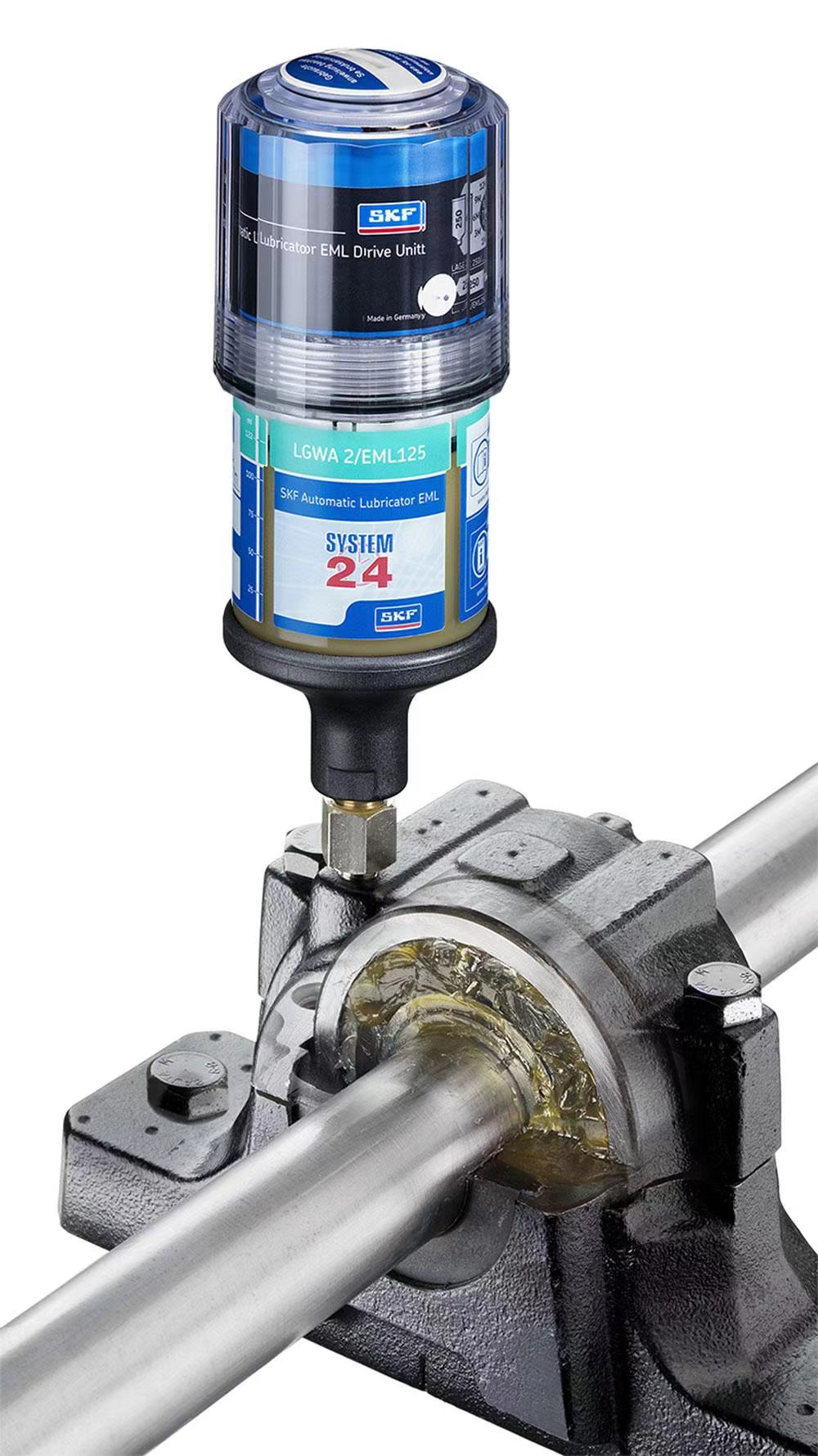
10. Consider Automatic Lubrication Systems
For equipment with continuous operation or difficult maintenance access, automatic lubrication systems can provide a more controlled grease supply.
They can help:
- Deliver smaller quantities of grease at regular intervals
- Reduce manual lubrication errors
- Improve lubrication consistency
- Reduce the risk of over-greasing
Typical applications include:
- Conveyor systems
- Electric motors
- Fans
- Pumps
- Production machinery
Recommended Grease Selection Guide
| Application | Recommended Grease | Key Features |
|---|---|---|
| CNC spindle/high-speed bearing | Klüber ISOFLEX TOPAS NB 52 | Low friction, high-speed stability |
| Electric motor bearing | NSK LR3, Kyodo Yushi Multemp SRL | Low noise, long service life |
| Long-life bearing application | Kyodo Yushi Multemp SRL | Long-life lubrication |
| High-temperature equipment | Klüber PETAMO GHY 133N | Thermal and oxidation stability |
| Wet environment | SKF LGWM 2 | Water resistance |
| Heavy-load equipment | SKF LGEM 2, Molykote BR2 Plus | Wear and EP protection |
Note: Product selection should always be based on bearing type, speed, temperature, load, environment, compatibility, and the equipment manufacturer's recommendations.
How to Extend Grease Relubrication Intervals
A practical approach is:
Correct grease selection → Correct grease quantity → Temperature control → Contamination prevention → Seal inspection → Condition monitoring → Interval optimization
Do not extend the interval simply by reducing the amount of grease or postponing scheduled maintenance.
Frequently Asked Questions
Can using more expensive grease extend the relubrication interval?
Not necessarily. A higher-priced grease does not automatically provide a longer service life. The grease must be suitable for the specific operating conditions.
Does over-greasing extend bearing lubrication life?
No. Excessive grease can increase churning resistance and temperature, which may actually shorten grease life.
How often should bearings be relubricated?
There is no universal interval. It depends on bearing type, speed, temperature, load, grease type, contamination, sealing, and operating hours.
Can long-life grease eliminate relubrication?
Not necessarily. Some applications may use factory-filled or long-life grease for extended periods, but the actual service life should be determined according to the equipment and lubricant manufacturer's recommendations.
Conclusion
Extending grease relubrication intervals requires more than simply reducing maintenance frequency. Correct grease selection, appropriate filling quantity, temperature control, contamination prevention, effective sealing, and condition monitoring all contribute to longer and more reliable lubrication performance.
For industrial equipment, selecting a suitable long life grease and establishing a lubrication program based on actual operating conditions can help reduce maintenance requirements while protecting bearings from premature failure.
Grease and Seal Compatibility: A Practical Guide
Grease Starvation in Bearings: Causes, Effects and Solutions
Related Article