Impact and Control of Grease Evaporation Loss Under High-Temperature Conditions
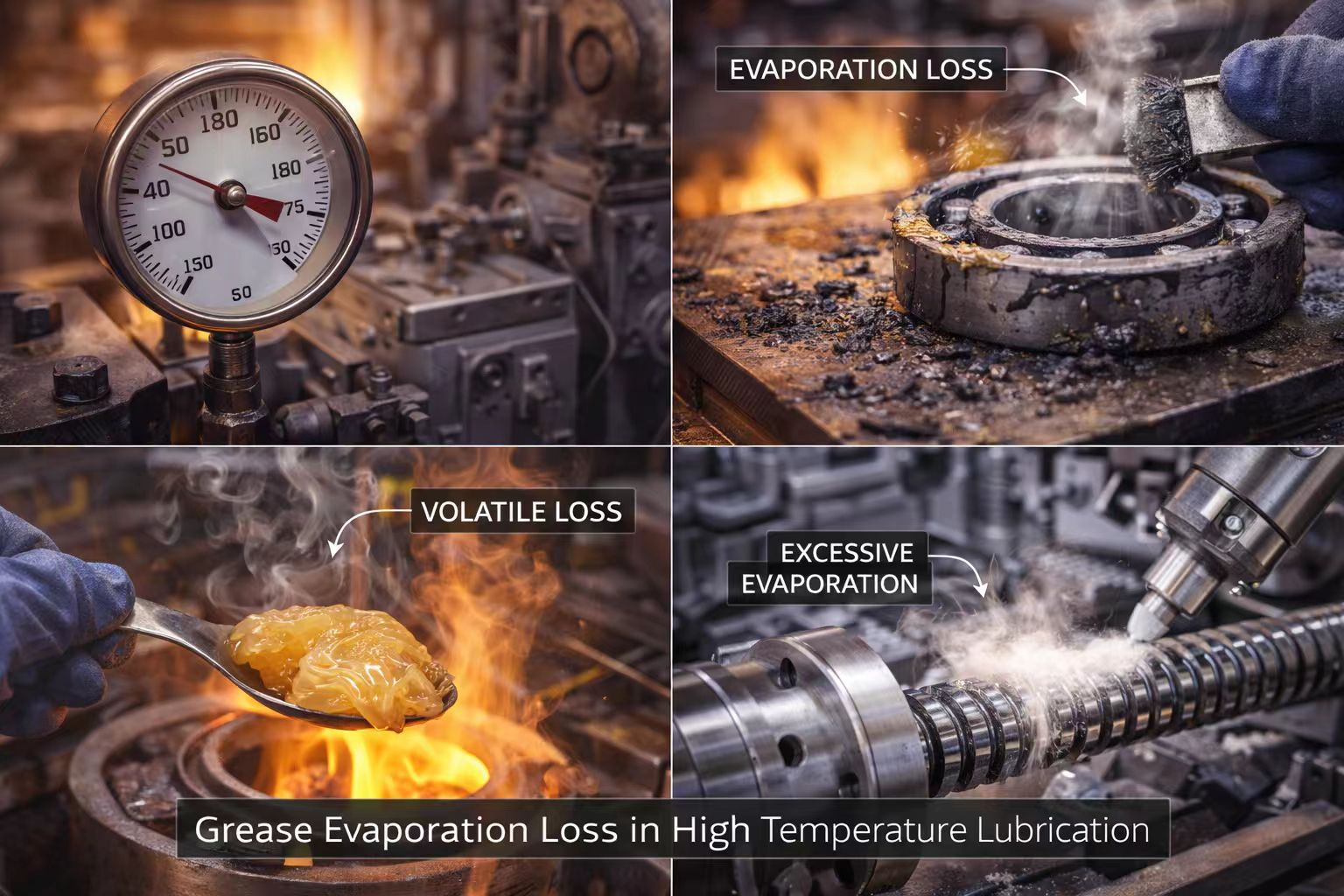
In high-temperature applications such as industrial bearings, electric motors, drying equipment, circulating hot-air systems, and high-temperature conveyor chains, grease evaporation loss is a critical factor affecting lubrication life and equipment reliability. Excessive evaporation can lead to lubricant depletion, grease hardening, and premature component failure.
Understanding the causes of evaporation loss and implementing proper control strategies helps maintain stable lubrication and extend equipment service life.
1. What Is Grease Evaporation Loss?
Lubricating grease is composed of base oil, thickener, and additives. Under elevated temperatures, several processes can lead to evaporation loss:
-
Volatilization of lighter components in the base oil
-
Thermal degradation of additives
-
Formation of volatile by-products during oxidation
Evaporation loss is typically measured as the percentage of mass lost under controlled temperature and time conditions.
Common test standards include:
-
ASTM D972 – Evaporation Loss of Lubricating Greases
-
DIN 51808 – Grease evaporation testing
The lower the evaporation loss, the better the lubricant retains its performance in high-temperature environments.
2. Key Impacts of Grease Evaporation Loss
2.1 Reduction of Lubrication Film Thickness
When base oil evaporates:
-
Oil film thickness decreases
-
Boundary lubrication increases
-
Metal-to-metal contact becomes more likely
This leads to increased friction, noise, and accelerated wear.
2.2 Grease Hardening and Consistency Changes
As base oil evaporates:
-
Thickener concentration increases
-
Grease becomes dry or hardened
-
Relubrication becomes difficult
Typical signs include:
-
Carbonized grease residues
-
Hardened grease deposits inside bearings
2.3 Increased Operating Temperature
Insufficient lubrication results in:
-
Higher friction
-
Increased heat generation
-
Faster evaporation of remaining oil
This creates a thermal runaway cycle, accelerating grease degradation.
2.4 Reduced Lubrication Life
Greases with high evaporation loss often require:
-
Shorter relubrication intervals
-
More frequent maintenance
-
Increased risk of unexpected equipment downtime
In automated production lines, this can significantly impact operational stability.
3. Factors Affecting Grease Evaporation Loss
3.1 Base Oil Type
Different base oils exhibit significantly different volatility levels:
-
Mineral oil → relatively higher evaporation
-
PAO synthetic oil → lower evaporation
-
Ester oils → moderate to low depending on structure
-
PFPE oils → extremely low evaporation
Low vapor pressure base oils are preferred for long-term high-temperature operation.
3.2 Base Oil Viscosity
-
Low viscosity oils evaporate more easily
-
Higher viscosity oils generally show lower evaporation loss
However, viscosity must also match equipment speed and lubrication requirements.
3.3 Operating Temperature
Evaporation increases exponentially with temperature.
For example:
A system operating at 150 °C may experience several times higher evaporation loss than at 120 °C.
3.4 Ventilation and System Design
Open systems:
-
Continuous air movement removes vapor
-
Evaporation increases
Sealed systems:
-
Retain vapors
-
Reduce evaporation rate
4. Engineering Methods to Control Evaporation Loss
4.1 Select Low-Volatility Base Oils
Recommended options include:
-
High-quality PAO synthetic oils
-
Synthetic ester oils
-
PFPE lubricants for extreme temperatures
These oils maintain lubrication stability under prolonged heat exposure.
4.2 Use High-Temperature Grease Formulations
Important properties include:
-
High oxidation stability
-
Strong additive package
-
High dropping point
-
Low evaporation characteristics
These factors help maintain grease structure during long-term operation.
4.3 Optimize Grease Filling Quantity
Over-lubrication can cause:
-
Excessive churning
-
Increased temperature
-
Accelerated evaporation
Correct grease fill levels help reduce internal friction and heat buildup.
4.4 Improve Sealing Design
Effective sealing helps:
-
Reduce airflow through the bearing housing
-
Prevent lubricant escape
-
Limit evaporation losses
4.5 Establish Proper Relubrication Intervals
Relubrication schedules should be based on:
-
Operating temperature
-
Load and speed conditions
-
Grease evaporation performance
Predictive maintenance programs can significantly improve lubrication reliability.
5. Recommended Lubricant Types for High-Temperature Applications
| Operating Temperature | Recommended Base Oil |
|---|---|
| ≤120 °C | Mineral oil or PAO |
| 120–160 °C | PAO or synthetic ester |
| 160–220 °C | Advanced synthetic oils |
| >220 °C | PFPE lubricants |
Selecting the correct lubricant base oil helps maintain stable lubrication under extreme temperatures.
Conclusion
Grease evaporation loss is one of the most important factors affecting lubrication performance in high-temperature environments. Controlling evaporation requires a comprehensive lubrication strategy that includes proper base oil selection, optimized grease formulation, correct lubrication quantity, and effective sealing design.
By reducing evaporation loss, industrial equipment can maintain stable lubrication, reduce wear, and significantly extend service life.
Precision Linear Guide Lubrication: Key Parameters and Selection Method
Why High-Speed Equipment Should Use Low NLGI Grade Grease
Related Article