The Impact of Grease Selection on Equipment Lifespan in Automated Production Lines
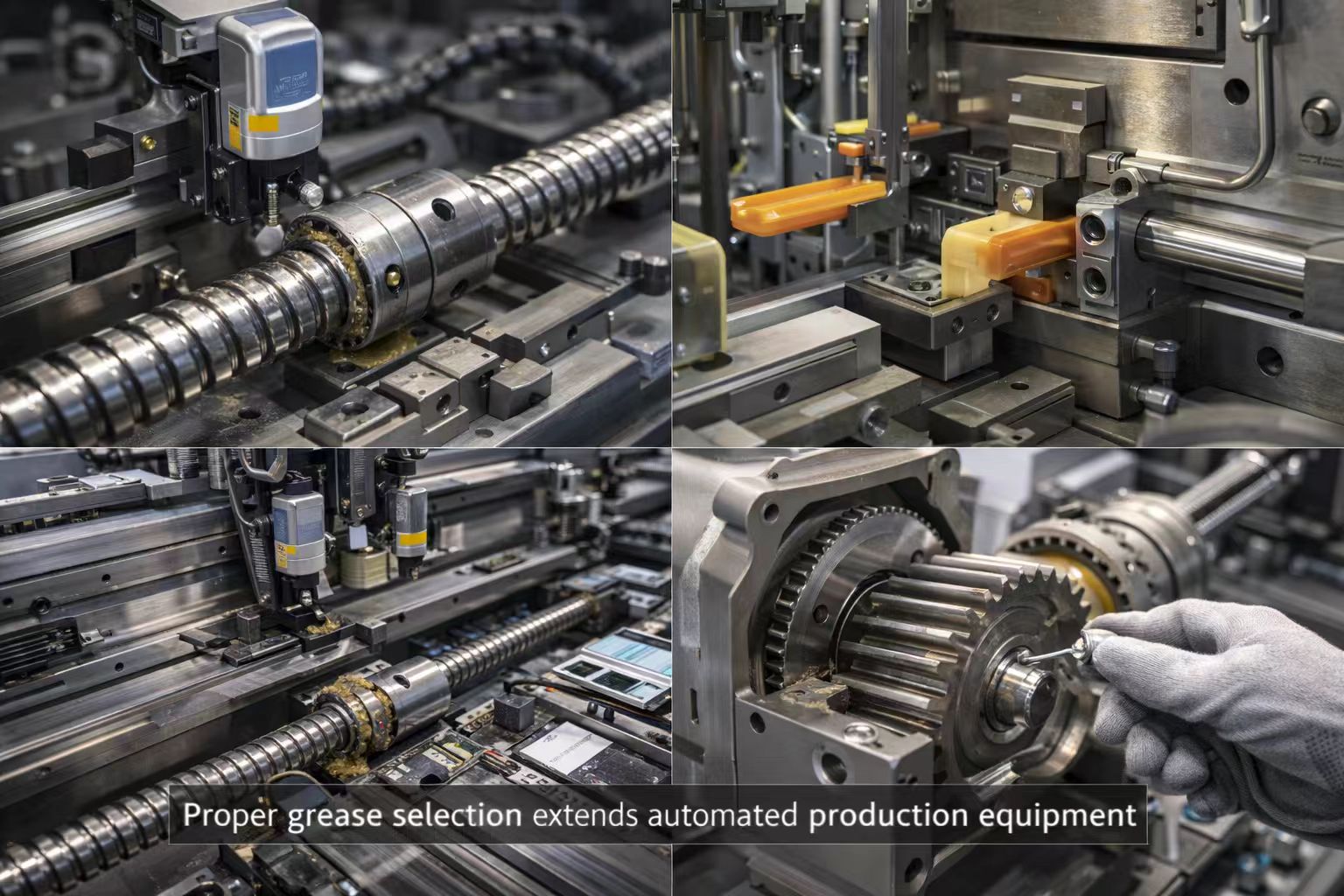
Automated production lines are widely used in electronics manufacturing, injection molding, and industrial machinery. Core components such as linear guides, ball screws, bearings, gear drives, and reducers operate continuously under high load, high speed, and frequent start-stop conditions. In this environment, automation equipment lubrication plays a decisive role in determining equipment reliability and service life.
Improper grease selection often leads to premature wear, increased vibration, positioning inaccuracies, and unexpected downtime. Conversely, selecting the right grease for each application can significantly extend component lifespan and stabilize long-term production.
Common Lubrication Challenges in Automated Production Lines
Automated systems integrate multiple motion components, each with different operating conditions. Typical lubrication challenges include:
-
High cycle frequency causing accelerated grease degradation
-
Mixed operating environments with heat, dust, and moisture
-
Compatibility issues with plastics, seals, or electronic components
-
Over-lubrication or insufficient lubrication leading to contamination or wear
These challenges make grease selection for automated machinery more complex than general industrial lubrication.
Key Grease Selection Factors Affecting Equipment Lifespan
Load and Speed Conditions
High-load components such as ball screws and gearboxes require greases with strong load-carrying capacity and stable oil film strength. For high-speed linear guides and bearings, low friction and shear stability are essential to reduce heat generation and energy loss.
Temperature Resistance and Oxidation Stability
Automated production lines often operate continuously, generating localized heat. Greases with poor thermal stability may harden, separate, or oxidize, resulting in lubrication failure. Selecting high-temperature-resistant greases helps maintain consistent lubrication performance over extended periods.
Material Compatibility and Cleanliness
In SMT lines and precision assembly equipment, grease migration or oil separation can contaminate sensitive components. Using low-bleed, low-volatility greases designed for clean environments reduces contamination risks and supports long-term equipment stability.
Relubrication Interval Optimization
A well-matched grease allows longer relubrication intervals without sacrificing protection. This reduces maintenance frequency, lowers labor costs, and minimizes human error, directly contributing to equipment lifespan extension.
Practical Impact on Equipment Reliability and Maintenance
Field experience shows that optimized grease selection can:
-
Reduce wear on linear motion components
-
Lower operating noise and vibration
-
Improve positioning accuracy and repeatability
-
Decrease unplanned downtime
-
Extend service life of bearings, ball screws, and drive systems
In automated production environments where uptime and consistency are critical, lubrication is not a consumable detail but a strategic maintenance decision.
Conclusion
The lifespan of automated production equipment is closely tied to lubrication strategy. Selecting the correct grease based on load, speed, temperature, and environmental requirements is essential for maintaining stable operation and maximizing asset value. A targeted approach to automation equipment lubrication and grease selection for automated machinery enables manufacturers to improve reliability, reduce maintenance costs, and achieve long-term production efficiency.
Low-Temperature Grease Application Guide for Precision Machinery
Common Lubrication Problems and Solutions for Injection Mold Ejector Pins and Sliders
Related Article