CNC Lubrication Troubleshooting: Common Problems and Solutions
CNC equipment can lose precision long before a bearing actually fails.
Unusual spindle noise, excessive temperature, grease leakage and abnormal vibration are common warning signs of lubrication problems.
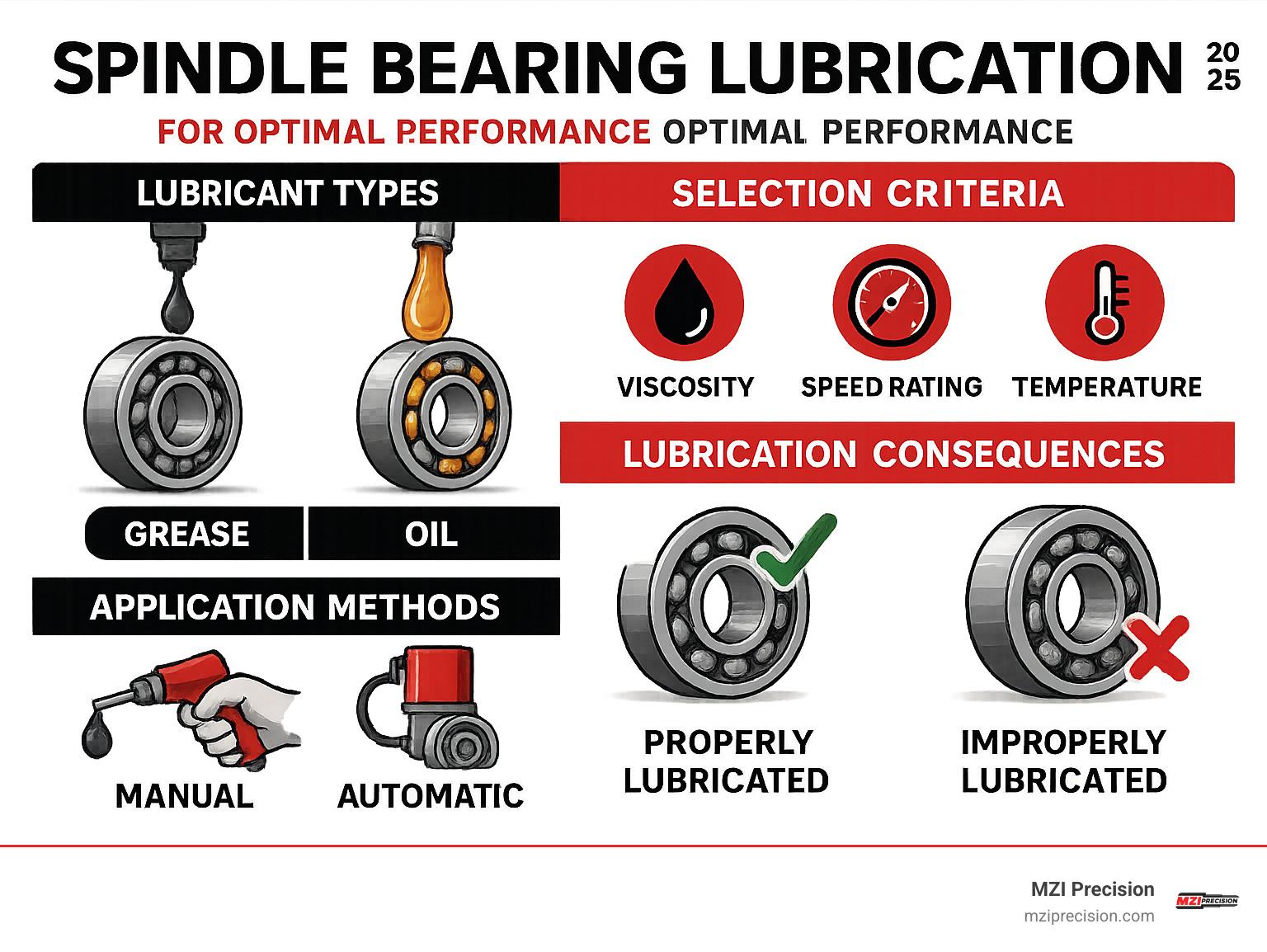
For CNC machines, the correct CNC lubrication strategy depends on spindle speed, bearing type, operating temperature, load and lubrication method. Choosing the wrong grease or using an incorrect grease quantity can negatively affect both bearing performance and machining accuracy.
1. CNC Spindle Temperature Is Too High
An overheated spindle does not always mean the bearing is damaged.
Possible lubrication-related causes include:
- Excessive grease filling
- Grease with unsuitable viscosity
- Excessive churning
- Incorrect grease selection
- Insufficient heat dissipation
Solution
Check the grease quantity first. For high-speed spindle bearings, excessive grease can increase friction and generate additional heat.
For precision spindle applications, Klüber ISOFLEX TOPAS NB 52 is one example of a grease designed for high-speed bearing applications, subject to the spindle manufacturer's specifications.
2. Abnormal Bearing or Spindle Noise
Unusual noise may indicate:
- Insufficient lubrication
- Contaminated grease
- Incorrect grease
- Bearing damage
- Excessive grease
If the noise appears shortly after relubrication, over-greasing or grease incompatibility should also be considered.
Solution
Check the bearing condition, grease condition and lubrication quantity before adding more grease.
3. Grease Leakage Around the Spindle
Grease leakage can be caused by:
- Excessive grease filling
- Damaged seals
- High operating temperature
- Excessive centrifugal force
- Incorrect grease consistency
Simply adding more grease can make the problem worse.
Solution
Inspect the sealing system and confirm whether the grease quantity is appropriate for the spindle.
4. Bearing Temperature Rises After Greasing
This is a common CNC lubrication problem.
If temperature increases immediately after relubrication, possible causes include:
Too much grease → excessive churning → friction increases → temperature rises
The bearing may require time to redistribute excess grease, but persistent high temperature should be investigated.
Solution
Check:
- Grease quantity
- Grease type
- Bearing speed
- Spindle operating temperature
5. Frequent Grease Relubrication Is Required
If CNC spindle bearings require frequent regreasing, check whether the lubricant is appropriate for the actual operating conditions.
Possible causes include:
- Short grease service life
- High operating temperature
- Grease leakage
- Excessive grease consumption
- Incorrect lubrication interval
Solution
Evaluate the grease's:
- Base oil viscosity
- Temperature capability
- Speed capability
- Mechanical stability
- Service life
6. Grease Hardens or Becomes Contaminated
Old grease may become harder or contaminated with:
- Metal particles
- Dust
- Coolant
- Moisture
Contaminated or degraded grease can negatively affect bearing lubrication.
Solution
Keep lubrication points clean and prevent cutting fluid or contaminants from entering the spindle bearing system.
When changing grease, also check compatibility with the existing lubricant.
7. Choosing the Right CNC Grease
CNC equipment does not use one universal grease.
High-Speed Spindle Bearings
Consider:
Klüber ISOFLEX TOPAS NB 52
Focus on:
- High-speed performance
- Low friction
- Suitable oil viscosity
Precision Bearing Applications
Depending on the equipment requirements, products from:
- Klüber
- NSK
- Kyodo Yushi
- SKF
may be considered.
The exact model should be selected based on the spindle manufacturer's recommendations rather than brand name alone.
CNC Lubrication Troubleshooting Checklist
| Problem | Possible Lubrication Cause | First Check |
|---|---|---|
| Spindle overheating | Excessive grease, unsuitable grease | Grease quantity and type |
| Abnormal noise | Insufficient/contaminated grease | Bearing and grease condition |
| Grease leakage | Over-greasing, seal problem | Seal and filling amount |
| High temperature after greasing | Excessive grease | Grease quantity |
| Frequent relubrication | Short grease life or leakage | Grease service condition |
| Bearing wear | Insufficient lubrication or contamination | Grease condition and sealing |
| Vibration | Lubrication or bearing problem | Bearing condition and grease |
How to Prevent CNC Lubrication Failure
1. Select Grease According to Spindle Speed
High-speed CNC spindles require grease capable of operating at the required speed without excessive friction and temperature rise.
2. Control Grease Quantity
Both under-greasing and over-greasing can cause problems.
3. Keep Coolant and Contaminants Away
CNC machining environments can expose bearings to coolant, chips and fine particles. Effective sealing is essential.
4. Monitor Temperature and Vibration
Changes in:
- Temperature
- Noise
- Vibration
- Spindle performance
can provide early warning of lubrication or bearing problems.
Frequently Asked Questions
Why does my CNC spindle become hot after adding grease?
Excessive grease is one possible reason. Too much grease increases churning and friction, particularly at high speeds.
Can ordinary bearing grease be used on a CNC spindle?
Not necessarily. CNC spindle bearings often operate at high speeds and require grease with appropriate friction, viscosity and speed characteristics.
How often should CNC spindle grease be replaced?
There is no universal interval. It depends on spindle speed, bearing design, temperature, grease type, operating hours and the manufacturer's maintenance recommendations.
Can I mix different CNC spindle greases?
Do not assume compatibility. Different base oils, thickeners and additive systems may interact negatively. Check compatibility before mixing.
Conclusion
CNC lubrication problems often appear as heat, noise, vibration or grease leakage rather than an obvious lubrication failure.
Before replacing a bearing, check the complete lubrication system:
Grease type → Grease quantity → Spindle speed → Temperature → Sealing → Contamination
Selecting the right CNC grease and maintaining the correct lubrication quantity can help protect spindle bearings, maintain machining accuracy and reduce unexpected downtime.
PFPE Grease Explained: Applications and Benefits
Why Cheap Grease Can Cost More in the Long Run
Related Article